<?xml version="1.0" encoding="UTF-8"?>
<?xml-stylesheet type="text/xsl" href="/stylesheets/feed.atom.xml" media="screen"?>
<feed xml:lang="en-US" xmlns="http://www.w3.org/2005/Atom">
  <id>tag:keough.nd.edu,2005:/news-and-events/news</id>
  <link rel="alternate" type="text/html" href="https://keough.nd.edu"/>
  <link rel="self" type="application/atom+xml" href="https://keough.nd.edu/news-and-events/news.atom"/>
  <id>tag:keough.nd.edu,2005:/latest</id>
  <title>Keough School of Global Affairs | News</title>
  <updated>2026-11-06T14:48:00-05:00</updated>
  <link rel="alternate" type="text/html" href="https://keough.nd.edu/"/>
  <link rel="self" type="application/atom+xml" href="https://keough.nd.edu//news-and-events/news.atom"/>
  <subtitle>The Keough School advances human dignity through research, policy, and practice; transformative educational programs; and partnerships for global engagement.</subtitle>
  <entry>
    <id>tag:keough.nd.edu,2005:News/186811</id>
    <published>2026-11-06T14:48:00-05:00</published>
    <updated>2026-11-06T15:23:09-05:00</updated>
    <link rel="alternate" type="text/html" href="https://keough.nd.edu/news-and-events/news/diplomat-sarah-beran-outlines-how-the-us-and-china-can-manage-their-rivalry/"/>
    <title>Diplomat Sarah Beran outlines how the US and China can manage their rivalry</title>
    <summary type="text">
      <![CDATA[The United States and China can use a rare moment of calm to responsibly navigate their rivalry, but it will take creative diplomacy, veteran diplomat Sarah Beran said during a visit to the University of Notre Dame.]]>
    </summary>
    <content type="html">
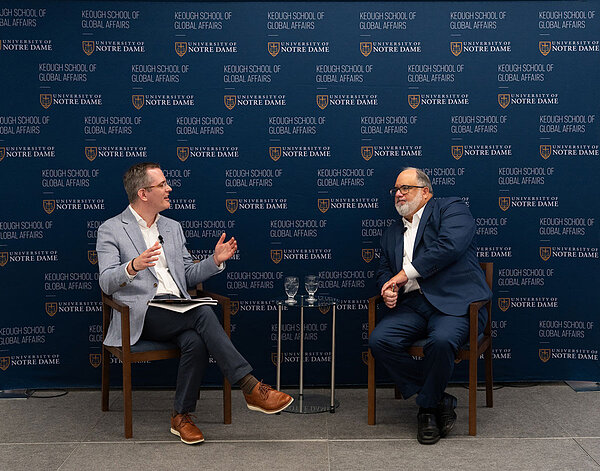
      <![CDATA[<figure class="image image-right"><img src="https://keough.nd.edu/assets/686467/1200x800_sarah_beran_dean_s_forum.jpg" alt="Diplomat Beran discussed how the U.S. and China can responsibly navigate their rivalry during a conversation with Keough School Dean Mary Gallagher as part of the Dean’s Forum on Global Affairs." width="600" height="400">
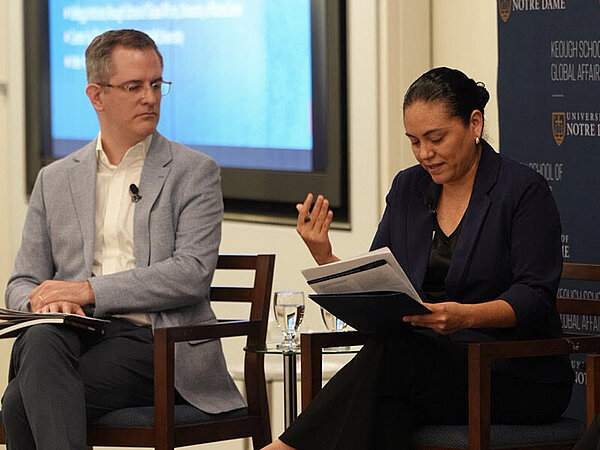
<figcaption>Diplomat Sarah Beran, right, discussed how the U.S. and China can responsibly navigate their rivalry during a conversation with Keough School Dean Mary Gallagher. Photo credit: Jena O’Brien.</figcaption>
</figure>
<p>The United States and China can use a rare moment of calm to responsibly navigate their rivalry, but it will take creative diplomacy, veteran diplomat <a href="https://keough.nd.edu/news-and-events/events/2026/10/29/competing-not-colliding-steering-u-s-china-relations-in-an-era-of-rivalry/">Sarah Beran</a> said during a visit to the University of Notre Dame.</p>
<p>The incoming president of the National Committee on U.S.-China Relations spoke Oct. 29 as part of a visit arranged by the <a href="https://keough.nd.edu/">Keough School of Global Affairs</a>. She also met with students to discuss policy careers in Asia and participated in a higher education roundtable on how the U.S.-China competition is affecting research and study abroad partnerships.</p>
<p>Beran joined <a href="https://keough.nd.edu/about/faculty-staff-directory/mary-gallagher/">Mary Gallagher</a>, the Marilyn Keough Dean of the Keough School, for a conversation on the U.S.-China rivalry as part of the <a href="https://keough.nd.edu/news-and-events/news/policy-perspective-connecting-scholarship-and-action-at-the-keough-school/">Dean’s Forum on Global Affairs</a>, a series designed to bring world leaders into conversation with Notre Dame students, faculty and the broader community around current global issues.</p>
<p>“This is a rare moment of stability and it is really incumbent on both sides to find some positive forward movement,” Beran said, noting that U.S. President Donald Trump and Chinese President Xi Jinping have already met twice this year, which is much more frequent than usual, and are scheduled to meet twice more, including at the Asia-Pacific Economic Cooperation summit in November 2026. “But it will not be easy. It will take creative diplomacy and continued efforts, not just at the governmental level, but also at the civil society level, to get there.”</p>
<p>Gallagher stressed the importance of managing how the United States and China compete.</p>
<p>“The two countries are rivals in technology, trade and security, and that rivalry is not going away,” Gallagher said. “The real question is whether it can be managed, and whether Washington and Beijing can compete without conflict.”</p>
<h2>Encouraging dialogue</h2>
<p>Beran, who served as senior director for China and Taiwan affairs at the National Security Council and deputy chief of mission at the U.S. Embassy in Beijing, said this year’s U.S.-China meetings support “strategic stability.” That landscape includes an AI working group, a crisis communications channel and continued counternarcotics and military-to-military talks, she said. But she urged modest expectations, given ongoing tensions over rare earth minerals and semiconductors as well as disagreements over how to deal with Russia, Iran and North Korea.</p>
<p>Beran sketched several possible scenarios for how the U.S.-China rivalry might unfold in the near future. Continued stability is most likely, she said, with both sides taking some actions the other sees as harmful, such as new export controls. A grand bargain is the least likely. A third possibility might be rapid deterioration or decoupling, sparked by a black swan event such as ships colliding in the South China Sea.</p>
<p>Beran said 2028 could be an inflection point, with the U.S. presidential election in November and Taiwan’s presidential election in January. She pointed to the National Committee’s <a href="https://www.ncuscr.org/program_category/track-ii-dialogues/">Track II dialogues</a> as a way to incorporate valuable perspectives from civil society and business representatives rather than relying solely on government channels.</p>
<h2>The importance of study abroad</h2>
<p>Beran discussed study abroad programs during her visit to Notre Dame, describing it as a way for citizens in the United States and China to gain a more accurate and nuanced understanding of each others’ countries.</p>
<p>At a morning roundtable co-hosted with the National Committee, about 35 participants from 14 universities explored research security, education partnerships and the importance of sending students to study in China. Gallagher noted that the number of American students studying there has fallen from about 11,000 to fewer than 2,000.</p>
<p>At the forum, Gallagher asked Beran about Xi’s invitation for 100,000 Americans to study in China. Beran praised more Americans traveling to China as a positive signal, but said students should also go beyond Chinese government programs, get outside of the bigger cities and meet everyday people in order to gain a better understanding of China, something she considers a national security imperative.</p>
<h2>Learning from practitioners</h2>
<figure class="image image-right"><img src="https://keough.nd.edu/assets/686466/1200x800_beran_class.jpg" alt="During her campus visit, Beran joined Dahjin Kim’s Approaching Asia class and shared insights on careers in Asia policy. Kyle Jaros, interim director of the Keough School’s Liu Institute for Asia and Asian Studies, moderated the conversation." width="600" height="400">
<figcaption>During her campus visit, Beran joined Dahjin Kim’s Approaching Asia class and shared insights on careers in Asia policy. Kyle Jaros, interim director of the Keough School’s Liu Institute for Asia and Asian Studies, moderated the conversation. Photo credit: Jennifer Lechtanski.</figcaption>
</figure>
<p>Beran’s visit provided Notre Dame students with an opportunity to hear from a career diplomat who has helped shape U.S.-China policy. <a href="https://keough.nd.edu/about/faculty-staff-directory/kyle-jaros/">Kyle Jaros</a>, interim director of the Keough School’s <a href="https://asia.nd.edu/">Liu Institute for Asia and Asian Studies</a>, moderated a conversation as part of the Approaching Asia class taught by <a href="https://keough.nd.edu/about/faculty-staff-directory/dahjin-kim/">Dahjin Kim</a>, assistant professor of Asian studies and global affairs and a core-affiliated faculty member of the Liu Institute. Students asked about chip export controls, China’s AI development and Chinese influence in Africa and the Pacific islands, as well as whether to specialize early in a policy career.</p>
<p>For Delaney Park, a sophomore global affairs and French major who attended the Dean’s Forum, the experience was a chance to learn from a 23-year veteran of the U.S. Foreign Service. She asked what advice Beran would give to future presidential candidates and listened as Beran described how a newly elected leader might signal priorities through public statements.</p>
<p>“It’s wonderful to profit from all this knowledge that people have gathered over their careers, especially as we’re learning as much as we can and preparing to go out into the real world,” said Park, who is also an undergraduate fellow of the <a href="https://ondisc.nd.edu/people/undergraduate-fellows/">O’Brien Notre Dame International Security Center</a>. “Being at Notre Dame has really taught me to keep an eye out for different talks because there’s no other place and no other time that we’re going to get to have this much information and learn for the fun of it.”</p>
<h2>Watch the Dean’s Forum Conversation</h2>
<p><iframe width="640" height="360" src="https://www.youtube.com/embed/Ye7F93Q6MGc?si=VAfDI2dsl8LO8BjM&amp;start=7" title="YouTube video player" frameborder="0" allow="accelerometer; autoplay; clipboard-write; encrypted-media; gyroscope; picture-in-picture; web-share" referrerpolicy="strict-origin-when-cross-origin" allowfullscreen="allowfullscreen"></iframe></p>]]>
    </content>
    <link rel="enclosure" type="image/jpeg" href="https://keough.nd.edu/assets/686465/1200x675_sarah_beran_dean_s_forum.jpg" title="Diplomat Beran discussed how the U.S. and China can responsibly navigate their rivalry during a conversation with Keough School Dean Mary Gallagher as part of the Dean’s Forum on Global Affairs."/>
    <author>
      <name>Josh Stowe</name>
    </author>
  </entry>
  <entry>
    <id>tag:keough.nd.edu,2005:News/186587</id>
    <published>2026-10-28T16:08:16-04:00</published>
    <updated>2026-11-02T12:05:17-05:00</updated>
    <link rel="alternate" type="text/html" href="https://keough.nd.edu/news-and-events/news/master-of-global-affairs-graduate-puts-policy-training-to-work-in-new-york-state-senate/"/>
    <title>Master of global affairs graduate puts policy training to work in New York State Senate</title>
    <summary type="text">
      <![CDATA[Omar Cham, a 2026 master of global affairs graduate, is putting his education to work as a fellow in the New York State Senate. His work builds on practical experience in governance and policymaking at the Keough School. ]]>
    </summary>
    <content type="html">
      <![CDATA[<figure class="image image-right"><img src="https://keough.nd.edu/assets/684857/omar_cham_1200x800.webp" alt="Master of global affairs alumnus Omar Cham is putting his education to work as a fellow in the New York State Senate." width="600" height="400">
<figcaption>Omar Cham, a 2026 graduate of the Keough School's Master of Global Affairs program, is putting his education to work as a fellow in the New York State Senate. Photo Credit: Omar Cham.</figcaption>
</figure>
<p>As speaker of The Gambia’s National Youth Parliament, Omar Cham honed an interest in policy, seeing how it could help improve people’s lives.</p>
<p>As a student at the <a href="https://keough.nd.edu/">Keough School,</a> he learned the ins and outs of how policy is actually made.</p>
<p>Now, as a fellow in the New York State Senate, Cham is putting his skills and interests to work.</p>
<p>In September, Cham started a nine-month stint as a<a href="https://www.nysenate.gov/newsroom/articles/2026/new-york-state-senate-graduate-fellowships"> fellow</a> with the office of New York State Senator <a href="https://www.nysenate.gov/senators/patricia-canzoneri-fitzpatrick">Patricia Canzoneri-Fitzpatrick</a>, who represents the state’s 9th District on Long Island. His duties include researching policy, writing memos, preparing briefs, drafting bills and supporting the senator’s office in responding to constituent concerns.</p>
<p>“Notre Dame’s vision of being a force for good in the world continues to resonate with me in the work that I do,” said Cham, a 2026 graduate of the <a href="https://keough.nd.edu/academics/master-of-global-affairs/">Master of Global Affairs</a> program. “And my time at the Keough School helped me develop the skills, perspective and network I need to make an impact.”</p>
<p><strong>Building policy skills </strong></p>
<p>Cham arrived on campus having seen how policy can make a difference. During his time as speaker of The Gambia’s National Youth Parliament, he was part of a larger movement that convinced legislators not to overturn a ban on female genital mutilation. He participated firsthand in community dialogues and campaigns to help educate the public, led voter education and observation initiatives, wrote position papers and reformed the Youth Parliament to include representation from women and people with disabilities.</p>
<p>At the Keough School, he deepened his knowledge as a <a href="https://keough.nd.edu/academics/master-of-global-affairs/concentrations/governance-and-policy/">governance and policy major</a>. Courses in global governance, comparative governance and policymaking and quantitative analysis showed him how policies work in practice, and how different countries and institutions apply them in different contexts.</p>
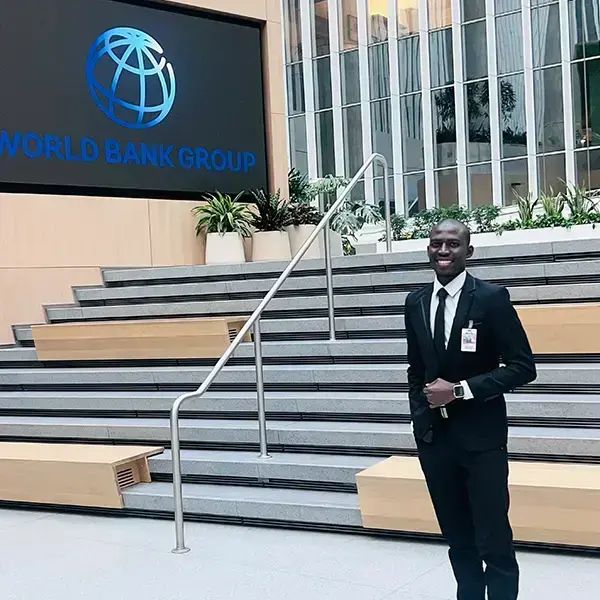
<figure class="image image-right"><img src="https://keough.nd.edu/assets/684855/omar_cham_600x600.webp" alt="Omar Cham is pictured outside the World Bank, during a site visit he participated in as a master of global affairs student." width="600" height="600">
<figcaption>As a master of global affairs student, Cham had the opportunity to network with officials at institutions including the World Bank, the Council on Foreign Relations and the Atlantic Council thanks to the D.C. Immersion course. Photo credit: Omar Cham.</figcaption>
</figure>
<p>In the school’s <a href="https://keough.nd.edu/academics/master-of-global-affairs/practicum-internship/i-lab/">Integration Lab</a> (i-Lab), he was part of a team that worked with the nongovernmental organization Aspire India to support universal education enrollment, which has been a national priority for India. His team helped to identify enablers of, and barriers to, enrollment and recommended ways to improve the program in a district in Odisha, a state in eastern India.</p>
<p>“That project was very practical,” Cham said. “It helped me to build research skills I didn’t have the opportunity to practice before, and it helped improve my teamwork and sharpen my presentation skills.”</p>
<p>The D.C. Immersion course led by <a href="https://keough.nd.edu/about/faculty-staff-directory/maura-policelli/">Maura Policelli</a>, professor of the practice at the Keough School and executive director of the school’s <a href="https://keough.nd.edu/about/keough-school-in-washington/">Washington Office</a>, enabled him to talk with officials at the World Bank, the Council on Foreign Relations, the Atlantic Council and the Center for Strategic and International Studies.</p>
<p>“That experience shows in real time how policies actually work,” Cham said. “How do you make proposals and recommendations? How do you assess the impact of a policy?”</p>
<p><strong>Finding mentors who opened doors </strong></p>
<p>Cham points to several mentors at the Keough School who helped him develop academically and professionally.</p>
<p>During his first semester, he took a global governance course with <a href="https://keough.nd.edu/about/faculty-staff-directory/erin-graham/">Erin Graham</a>, associate professor of global affairs and director of the governance and policy major in the Master of Global Affairs program. Cham said she set the tone for his experience thanks to “her ability to bring the best out of you.”</p>
<p><a href="https://keough.nd.edu/about/faculty-staff-directory/lisa-schirch/">Lisa Schirch</a>, the Richard G. Starmann, Sr. Professor of the Practice of Peace Studies, taught a strategic peacebuilding course that gave Cham a practical look at conflict transformation and inspired further research. As part of a class project, he studied how Italian immigration policies affected migrants. Schirch encouraged him to expand his research, and he conducted interviews and group discussions in Italy with support of the Keough School’s <a href="https://nanovic.nd.edu/">Nanovic Institute for European Studies</a>, proposing reforms that would help support migrants’ dignity.</p>
<p><a href="https://keough.nd.edu/about/faculty-staff-directory/paul-perrin/">Paul Perrin</a>, academic director of the i-Lab and professor of the practice in global affairs and global health, and the i-Lab team helped Cham deepen his collaborative problem-solving skills, providing him with valuable experiences and perspectives, he said. Policelli encouraged Cham as he networked and applied for jobs and <a href="https://keough.nd.edu/about/faculty-staff-directory/mckenna-pencak/">McKenna Penczak</a>, associate director of professional development and alumni engagement, supported his job search and application processes.</p>
<p>“Notre Dame mission is written all over where I am today,” Cham said. “The Keough School prepared me to be a changemaker, and I’m carrying that mission forward into all the work I do.”</p>
<hr>
<h2>Master of Global Affairs Program</h2>
<p>The two-year master of global affairs degree provides rigorous professional training, close engagement with policymakers, multi-disciplinary faculty and a network of students from around the world, alongside extended fieldwork with global partners working to address global challenges.</p>
<p><a href="https://keough.nd.edu/academics/master-of-global-affairs/" class="btn btn-cta btn-more">Master of Global Affairs</a></p>]]>
    </content>
    <link rel="enclosure" type="image/webp" href="https://keough.nd.edu/assets/684856/omar_cham_1200x675.webp" title="Master of global affairs alumnus Omar Cham is putting his education to work as a fellow in the New York State Senate."/>
    <author>
      <name>Josh Stowe</name>
    </author>
  </entry>
  <entry>
    <id>tag:keough.nd.edu,2005:News/186579</id>
    <published>2026-10-28T14:38:00-04:00</published>
    <updated>2026-10-28T15:22:30-04:00</updated>
    <link rel="alternate" type="text/html" href="https://keough.nd.edu/news-and-events/news/from-remedy-to-prevention-researchers-call-for-proactive-approach-to-protect-the-human-right-to-water/"/>
    <title>From remedy to prevention: Researchers call for proactive approach to protect the human right to water</title>
    <summary type="text">
      <![CDATA[Protecting the human right to safe water, sanitation and hygiene means preventing harm before it occurs rather than assigning responsibility afterward, University of Notre Dame researchers explain in a new commentary in Nature Water. Their work, published ahead of a major global water conference, can inform policymakers and practitioners. ]]>
    </summary>
    <content type="html">
      <![CDATA[<figure class="image image-right"><img src="https://keough.nd.edu/assets/684798/ellis_adams_water_rights_1200x800.jpg" alt="A woman fills water jugs from a well in  Mojo, Ethiopia. Photo credit: USAID via Flickr." width="600" height="400">
<figcaption>A woman fills water jugs from a well in Mojo, Ethiopia. Globally, approximately 1 in 4 people lack access to safe water and sanitation. Photo credit: USAID via <a href="https://www.flickr.com/photos/usaid_images/6806366983/in/photolist-bnspLT-9jbvXX-48qTVA-9jeBt7-osAaVB-TcjaeB-aoY6Lb-owoaZM-2opCgAw-34Gqaf-2kRnTmZ-34C8sg-EH1unG-2qyynmV-s9QKhS-EcTo9m-pFrJ2H-2sjrkEg-cqJQP5-Ny7mhm-pAELSy-34G9eu-QDhwTA-cqJRpL-pAEJ1b-pjcNvu-pjbC38-pyDTNf-5YoQyK-2FWA5h-2opHsVg-2opGhZn-s7FBa3-cqJRYy-2opEZk8-9JDcp9-2opEWsj-s7GgAG-2opDkUR-wZH4oj-5m1yL9-wZHkFh-22nWnQn-2opHmBz-71fWCG-bJh4FH-2opC6BR-2opH3uE-s9VwdV-8RJ9S3">Flickr</a>.</figcaption>
</figure>
<p>More than 2 billion people, or approximately one quarter of the world’s population, lack access to safe water, sanitation and hygiene according to the <a href="https://www.unicef.org/press-releases/fast-facts-1-4-people-globally-still-lack-access-safe-drinking-water-who-unicef">United Nations Children’s Fund</a>. Today, 16 years after the U.N. General Assembly recognized this access as a <a href="https://www.unwater.org/water-facts/human-rights-water-and-sanitation">fundamental human right</a>, its legal protection is well established but the reality on the ground lags behind.</p>
<p>Protecting the human right to water means preventing harm before it occurs rather than assigning responsibility afterward, University of Notre Dame researchers argue in a new commentary published ahead of a major global water conference.</p>
<p>Keough School of Global Affairs faculty members <a href="https://keough.nd.edu/about/faculty-staff-directory/ellis-adjei-adams/">Ellis Adams</a> and <a href="https://law.nd.edu/directory/diane-desierto/">Diane Desierto</a> — who also holds a joint appointment in the <a href="https://law.nd.edu/">Notre Dame Law School</a> — are among the authors of the commentary in <a href="https://doi.org/10.1038/s44221-026-00740-8">Nature Water</a> that calls for better implementation of <a href="https://www.un.org/sustainabledevelopment/water-and-sanitation/">universal water and sanitation access</a> as part of the U.N.’s Sustainable Development Goals. They say a prevention-first approach can provide an effective blueprint to protect human rights for communities worldwide.</p>
<p>The need to accelerate progress on safe water and sanitation will be on the agenda at the December 2026 <a href="https://sdgs.un.org/conferences/water2026">United Nations Water Conference</a>, co-hosted by Senegal and the United Arab Emirates.</p>
<p>“We hope that this convening will help catalyze new ways for policymakers and practitioners to consider what more we can do as we approach the 2030 deadline for the Sustainable Development Goals,” said Adams, associate professor of geography and environmental policy in the Keough School and a core-affiliated faculty member of the school’s<a href="https://pulte.nd.edu/"> Pulte Institute for Global Development</a>.</p>
<h2>Why prevention first</h2>
<p>In their commentary, the researchers called for focusing on how different actors, including private companies and government regulators can help prevent harm from occurring in the first place rather than assigning responsibility once it has already occurred.</p>
<blockquote class="pull">
<p>“We need more proactive approaches in order to realize the human right to water.”</p>
</blockquote>
<p>Adams said one issue with looking backward is that harm sometimes surfaces long after the activity that caused it, making it harder to remediate. A mining company, for instance, might leave behind toxic chemicals from its work. Years later, when a community begins to show the effects, the company may be long gone or bought out by another company that hopes to avoid taking on damages.</p>
<p>Desierto said that remediation may no longer be sufficient to restore the global water cycle to what it once was.</p>
<p>“At this stage of our climate crisis, prevention is an inevitable strategy to an era of water inadequacy for present and future generations,” said Desierto, professor of law and global affairs. “We need more proactive approaches in order to realize the human right to water and the related right to a safe, clean, healthy and sustainable environment.”</p>
<h2>A contextual approach</h2>
<p>Adams said the approach links water-security and governance conditions to challenges in achieving clean water as a human right. Context is critical to protecting that right when communities have different views of what constitutes harm.</p>
<p>“Water is never just water,” said Adams, who is also affiliated with Notre Dame’s <a href="https://environmentalchange.nd.edu/">Environmental Change Initiative</a> and <a href="https://globalhealth.nd.edu/">Eck Institute for Global Health.</a> “When two communities say their right to water has been violated, it doesn’t mean the same thing.”</p>
<blockquote class="pull">
<p>Protecting the right to water requires understanding what water means to different communities.</p>
</blockquote>
<p>For one community, he said, the harm might be mining pollution that affects the food supply. For another, it may be water that’s unsafe for mixing infant formula or making tea. For still others, it may be damage to a water site that is important for prayer, meditation or other cultural and religious activities.</p>
<p>Laws and institutions matter too, he said. For example, in Chile, the <a href="https://iwaponline.com/wp/article/28/3/393/111120/Reform-of-the-Chilean-water-code-in-2022-shift">1981 water code</a> long treated water as an economic good over a cultural one, so a mining company’s use could take priority over a community’s cultural claim.</p>
<h2>Working with the private sector</h2>
<p>Companies in water-intensive industries — including mining, agriculture, beverage and garment — can integrate this approach into existing due-diligence processes that examine water risk, stewardship and human rights, Adams said. Such a move fits into the private sector’s growing recognition of the need for corporate social responsibility, he added.</p>
<p>That was the approach that Adams and other Notre Dame researchers presented to the U.N. at a <a href="https://keough.nd.edu/news-and-events/news/keough-school-faculty-present-water-access-and-human-rights-expertise-at-un/">2022 forum</a> in Geneva. They shared a framework aimed at helping communities <a href="https://crcresearch.github.io/realizingrightsforwater/">realize water rights</a>.</p>
<p>That project now includes a <a href="https://crcresearch.github.io/realizingrightsforwater/assessment.html">dashboard</a> for companies to use in order to assess the potential risks involved in their work before projects begin. Users enter proposed activities, and the tool maps documented water-security and governance red flags onto a human-rights risk profile, working much like a traffic light to encourage preemptive risk assessment.</p>
<p>The work was commissioned by the mining company BHP, which had no role in the design, analysis or conclusions of the research.</p>
<p>“This was a way to show that scholars and the private sector can work together, and the U.N. wanted our project to highlight that,” Adams said. “These companies already conduct due diligence activities. A mining company, for instance, wants to know how long a project would last and how much of a mineral would be recovered. We want them to take that same analysis and time frame and incorporate the human right to access water.”</p>
<p>Engaging business is not an endorsement of any industry, researchers said. The goal is coordination among all the actors involved.</p>
<p>“Our interdisciplinary research provides legal, hydrological and environmental guidance for water-intensive activities that can help coordinate prevention by engaging both the public and private sectors,” Desierto said.</p>
<p>A future phase of the project would put the dashboard to use in places with proposed water-intensive industrial projects, Adams said. Researchers hope future work will examine how it performs in practice and said it can also serve as a teaching tool.</p>
<h2>Engaging community and government stakeholders</h2>
<figure class="image image-right"><img src="https://keough.nd.edu/assets/684797/ellis_diane_1200x800.jpg" alt="Notre Dame researchers Ellis Adams, left, and Diane Desierto, right, are pictured." width="600" height="400">
<figcaption>Notre Dame researchers Ellis Adams and Diane Desierto want their work on water, sanitation and hygiene to inform policymakers and practitioners. Photo credit: University of Notre Dame. </figcaption>
</figure>
<p>Adams stressed that a better process is intensely consultative, involving communities and national government delegates in addition to private companies.</p>
<p>For governments, that means consultation and education. States are the guarantors of the right to water, Adams said, but the average policymaker may not know what that entails. Governance operates at national and communal levels, he said, and consultation often needs to reach beyond the mining site to communities downstream or upstream and across borders where water is shared.</p>
<p>As the U.N. looks to accelerate innovation to provide universal clean water access, Adams said the prevention-first model that acknowledges the need to work with public and private sectors could yield better results.</p>
<p>“This is a good time for us to take stock and think about what more we need to do,” Adams said, “and we think this approach can help protect the human right to water in different global contexts.”</p>
<p>Adams and Desierto co-authored the commentary with Marc F. Müller and Julie C. Faure, researchers who are both affiliated with the Swiss Federal Institute of Aquatic Science and Technology.</p>
<p><br><br></p>]]>
    </content>
    <link rel="enclosure" type="image/jpeg" href="https://keough.nd.edu/assets/684796/ellis_adams_water_rights_1200x675.jpg" title="A woman fills water jugs from a well in  Mojo, Ethiopia. Photo credit: USAID via Flickr."/>
    <author>
      <name>Josh Stowe</name>
    </author>
  </entry>
  <entry>
    <id>tag:keough.nd.edu,2005:News/186500</id>
    <published>2026-10-23T17:39:00-04:00</published>
    <updated>2026-10-23T17:41:47-04:00</updated>
    <link rel="alternate" type="text/html" href="https://keough.nd.edu/news-and-events/news/from-curiosity-to-research-notre-dame-student-maps-education-inequality-in-rio/"/>
    <title>From curiosity to research: Notre Dame student maps education inequality in Rio</title>
    <summary type="text">
      <![CDATA[Ana Beatriz D. Maya Ferreira began investigating Rio de Janeiro’s education deserts as a high school student curious about her hometown. At Notre Dame, she turned that curiosity into published research through a Keough School lab that helps students explore real-world problems rooted in their own experiences.]]>
    </summary>
    <content type="html">
      <![CDATA[<figure class="image image-right"><img src="https://keough.nd.edu/assets/684125/rebecca_hardin_class.jpg" alt="Junior Ana Beatriz D. Maya Ferreira (center) talks with Professor Rebecca Hardin (left) and Abigail Merolle (right), project manager for the online learning platform Gala. Maya Ferreira published her research, which explores education deserts in Rio de Janeiro, on the platform. Photo credit: Daniel Hilles." width="600" height="400">
<figcaption>Junior Ana Beatriz D. Maya Ferreira (center) talks with Professor Rebecca Hardin (left) and Abigail Merolle (right), project manager for the online learning platform Gala. Maya Ferreira published her research, which explores education deserts in Rio de Janeiro, on the platform. Photo credit: Daniel Hilles.</figcaption>
</figure>
<p>Ana Beatriz D. Maya Ferreira began investigating Rio de Janeiro’s education deserts as a high school student curious about her hometown. At the University of Notre Dame, she turned that curiosity into published research that others can now build on.</p>
<p>Her work, which shows how inequality and topography left parts of the city without readily accessible K-12 schools, was published online as part of a poverty and innovation lab taught by Keough School faculty member <a href="https://keough.nd.edu/about/faculty-staff-directory/rebecca-hardin/">Rebecca Hardin</a>.</p>
<p>Hardin teaches with <a href="https://www.learngala.com/">Gala</a>, an open-source online learning platform where students, researchers and professionals can publish their research and share it, either more narrowly with peers, or more widely with the public. She uses the platform and her lab to help students investigate questions rooted in their own experiences and share their findings beyond the classroom.</p>
<p>“It was very interesting to research more about the place that I came from, applying all the skills and concepts that I’ve learned here at Notre Dame,” said Maya Ferreira, a junior global affairs and economics major who is minoring in French. “It was a great opportunity to take a deeper look at the issue and share my work with other people who work on education equity.”</p>
<p><strong>Mapping Rio’s education gaps</strong></p>
<p>Maya Ferreira found that socioeconomic factors were significant contributors to education deserts, which she defined as locations that were at least an hour’s drive away from a school. She also found that more affluent areas had more schools, while lower-income areas had fewer. In addition, she discovered that topography made a difference: More mountainous areas had fewer schools.</p>
<p>For her project, Maya Ferreira mapped 140 data points, using Geographic Information System software to analyze Rio’s spatial patterns. She investigated variables including population density, income and housing quality.</p>
<p>Ultimately, she <a href="https://www.learngala.com/cases/f2c679da-037d-4c6b-8e26-8b0e000b5cbf/">published her research</a> on Gala and presented it to her classmates in Hardin’s lab. The findings illustrate how access to education can reflect not only economic inequality but also the physical geography of a city.</p>
<p>“I appreciated the opportunity to explore this issue from my hometown in more depth, creating work that people working on this issue may find helpful,” she said.</p>
<p><strong>Supporting active learning</strong></p>
<figure class="image image-right"><img src="https://keough.nd.edu/assets/684123/rebecca_hardin_class_2.jpg" alt="Junior Ana Beatriz D. Maya Ferreira (left) talks with Professor Rebecca Hardin (right)." width="600" height="400">
<figcaption>Maya Ferreira’s project exemplifies what Hardin wants to accomplish in her poverty and innovation lab. The course helps students build research skills by inviting them to explore questions rooted in their own experiences. Photo credit: Daniel Hilles.</figcaption>
</figure>
<p>Hardin enjoyed seeing Maya Ferreira dive into her research. That level of engagement is something she wants to cultivate in her classes and with Gala.</p>
<p>“Ana used this learning experience as a way to bring unanswered questions from her home into the classroom, share that with her peers and enhance her own understanding of her home region and the educational justice issues it experiences,” said Hardin, professor of sustainable development at the <a href="https://keough.nd.edu/">Keough School of Global Affairs</a> and a core-affiliated faculty member of the school’s <a href="https://pulte.nd.edu/">Pulte Institute for Global Development</a>.</p>
<p>Hardin, who directs Gala, brought the platform to Notre Dame from the University of Michigan. She envisioned it as a tool to provide case-based learning for students, particularly those who might not be able to access more resource-intensive labs and field immersions.</p>
<p>More broadly, Hardin uses Gala to facilitate authentic learning — an educational approach that encourages students to engage with real-world problems, and one that she herself has studied. Hardin co-authored research in the <a href="https://doi.org/10.1128/jmbe.00218-25">Journal of Microbiology &amp; Biology Education</a> showing that research-based modules for <a href="https://www.learngala.com/catalog/libraries/ocelots">teaching tropical biology and conservation</a> helped students better engage with and learn new concepts.</p>
<p>Hardin is pleased by how her students have embraced authentic learning. When she planned her six-week course, she wanted students to see communities that experience poverty as sources of innovation, and to engage with best practices in creating and circulating affordable, open educational resources.</p>
<p>Maya Ferreira embraced that challenge. She is now pursuing independent study with Hardin, further revising her own research for peer-reviewed publication and analyzing forestry-based content from vocational and technical campus instructors from across Brazil who use Gala.</p>
<p>“I found it was possible to have students meaningfully engage with questions and experiences that sparked their curiosity during this short time frame and then build on that if it dovetails with their professional aspirations,” Hardin said. “I am delighted to help our undergraduates develop their research skills, explore poverty-related topics in more depth and produce work that can inform others who are studying and working on these issues.”</p>]]>
    </content>
    <link rel="enclosure" type="image/jpeg" href="https://keough.nd.edu/assets/684124/rebecca_hardin_class_feature.jpg" title="Junior Ana Beatriz D. Maya Ferreira (center) talks with Professor Rebecca Hardin (left) and Abigail Merolle (right), project manager for the online learning platform Gala. Maya Ferreira published her research, which explores education deserts in Rio de Janeiro, on the platform. Photo credit: Daniel Hilles."/>
    <author>
      <name>Josh Stowe</name>
    </author>
  </entry>
  <entry>
    <id>tag:keough.nd.edu,2005:News/186323</id>
    <published>2026-10-16T15:36:00-04:00</published>
    <updated>2026-10-16T15:38:38-04:00</updated>
    <link rel="alternate" type="text/html" href="https://keough.nd.edu/news-and-events/news/notre-dame-scholar-to-help-islamic-educators-engage-arts-humanities-to-foster-dialogue-scholarly-diversity/"/>
    <title>Notre Dame scholar to help Islamic educators engage arts, humanities to foster dialogue, scholarly diversity</title>
    <summary type="text">
      <![CDATA[Notre Dame religion scholar Ebrahim Moosa will explore how using the arts and humanities in Islamic theological education might promote greater dialogue and scholarly diversity within Muslim communities and with other faith traditions.]]>
    </summary>
    <content type="html">
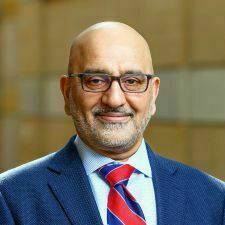
      <![CDATA[<figure class="image image-right"><img src="https://ansari.nd.edu/assets/656138/ebrahim_moosa_225.jpg" alt="The image features a man with glasses and a graying beard, dressed in a professional navy blue blazer and a red and blue striped tie. He is smiling warmly against a soft-focus architectural background, conveying a friendly yet distinguished presence." width="225" height="225"></figure>
<p>Notre Dame religion scholar<a href="https://keough.nd.edu/about/faculty-staff-directory/ebrahim-moosa/"> Ebrahim Moosa</a> will explore how using the arts and humanities in Islamic theological education might promote greater dialogue and scholarly diversity within Muslim communities and with other faith traditions.</p>
<p>Moosa, the Mirza Family Professor of Islamic Thought and Muslim Societies in Notre Dame’s <a href="https://keough.nd.edu/">Keough School of Global Affairs</a>, will work with two dozen Muslim theologians, artists and educators from Africa, North America and South Asia as part of the Pedagogies of Muslim Humanities project.</p>
<p>A product of traditional Islamic education himself, Moosa said he sees opportunities to address a gap in it. Many Islamic seminaries (both madrasas in the Sunni tradition and ḥawzas in the Shiʿa tradition) miss the opportunity to engage the humanities tradition produced by Muslim civilization, he said. Addressing that gap could help students cultivate traits such as curiosity, humility and openness to learning from other perspectives.</p>
<p>“Without these qualities, it is difficult for students to have meaningful, constructive conversations with people from different backgrounds,” Moosa said. “This project aims to revitalize the role of the arts and humanities in Islamic theological education to foster a culture of scholarly diversity and critical thinking, which is crucial for engaging with one’s own tradition as well as with people from other traditions.”</p>
<p>Key activities will include a 10-month virtual course on Islamic aesthetics, a 10-day residency at a museum of Islamic art and mentored community-based implementation where educators try out new curricula in their institutions. The project is supported by a three-year grant from the <a href="https://templetonreligiontrust.org/">Templeton Religion Trust</a>, which seeks to enrich the conversation about religion.</p>
<p>The project builds on Moosa’s earlier work as a religion scholar who is interested in revitalizing the intellectual culture of Muslim societies. In 2017, he launched the <a href="https://madrasadiscourses.nd.edu/">Madrasa Discourses</a> project engaging recently graduated Muslim theologians from South Asia.</p>
<p>Madrasa Discourses created opportunities for traditional Muslim scholars to deepen their theological and scientific literacy. Many explored their faith tradition and its resources to grapple with the philosophical challenges posed by new scientific worldviews and technologies. The project has hosted three cohorts in three countries, reaching over 100 educators.</p>
<p>Moosa is a core-affiliated faculty member of the Keough School’s <a href="https://ansari.nd.edu/">Ansari Institute for Global Engagement With Religion</a>, where he directs <a href="http://contendingmodernities.nd.edu/">Contending Modernities</a>, the global research and education initiative examining the interaction among Catholic, Muslim and other religious and secular forces in the world. He is also a faculty fellow of the Keough School's<a href="http://asia.nd.edu/"> Liu Institute for Asia and Asian Studies</a>.</p>
<p class="attribution">Originally published by <span class="rel-author">Josh Stowe</span> at <span class="rel-source"><a href="https://ansari.nd.edu/news-events/news/notre-dame-scholar-to-help-islamic-educators-engage-arts-humanities-to-foster-dialogue-scholarly-diversity/">ansari.nd.edu</a></span> on <span class="rel-pubdate">October 16, 2026</span>.</p>]]>
    </content>
    <author>
      <name>Josh Stowe</name>
    </author>
  </entry>
  <entry>
    <id>tag:keough.nd.edu,2005:News/186192</id>
    <published>2026-10-12T14:59:00-04:00</published>
    <updated>2026-10-12T14:59:52-04:00</updated>
    <link rel="alternate" type="text/html" href="https://keough.nd.edu/news-and-events/news/prioritizing-people-and-the-planet-cardinal-turkson-stresses-dignity-integral-ecology-during-visit-to-notre-dame/"/>
    <title>Prioritizing people and the planet: Cardinal Turkson stresses dignity, integral ecology during visit to Notre Dame </title>
    <summary type="text">
      <![CDATA[Cardinal Peter Turkson visited campus October 4-6, meeting with faculty, students and administrators in the University’s Keough School of Global Affairs to share his perspectives as a leading voice on Catholic social teaching, justice and integral human development. ]]>
    </summary>
    <content type="html">
      <![CDATA[<figure class="image image-right"><img src="https://keough.nd.edu/assets/682335/katongole_turkson_class.jpg" alt="Cardinal Peter Turkson visited Rev. Emmanuel Katongole’s ethical practice seminar, where he took questions from global affairs students. Photo credit: Daniel Hilles." width="600" height="400">
<figcaption>Cardinal Peter Turkson visited Rev. Emmanuel Katongole’s ethical practice seminar, where he took questions from global affairs students. Photo credit: Daniel Hilles.</figcaption>
</figure>
<p>Human dignity and environmental sustainability are interconnected parts of a holistic vision that can help changemakers address global challenges as they work toward a more just and peaceful world, Cardinal Peter Turkson said during his recent visit to the University of Notre Dame.</p>
<p>Turkson, the chancellor of the Pontifical Academies of Social Sciences and Sciences, visited campus October 4-6, beginning with a celebration of the Eucharist at the Basilica of the Sacred Heart. He met with faculty, students and administrators in the University’s <a href="https://keough.nd.edu/">Keough School of Global Affairs</a> to share his perspectives as a leading voice on Catholic social teaching, justice and integral human development.</p>
<p>“Integral human development makes an important point,” the Ghanaian prelate said during a visit to an undergraduate global affairs class, where he explained the need for a moral framework that centers the dignity of each person and the whole person. “Everything is interconnected, and everything is interdependent.”</p>
<p>Turkson underscored that message throughout his visit, analyzing global challenges including conflict, climate change and poverty alleviation through a people-centered approach inspired by Catholic social teaching and the integral ecology of Pope Francis’ encyclical Laudato si’. The encyclical emphasized care for creation in a world threatened by climate change and Turkson led the team that produced the first draft through the Pontifical Council of Justice and Peace.</p>
<h2>Sharing insights with students</h2>
<figure class="image image-right"><img src="https://keough.nd.edu/assets/682288/shea_kelly.jpg" alt="Shea Kelly, a first-year global affairs major, asked Turkson about his perspective on sustainable development." width="600" height="400">
<figcaption>Shea Kelly, left, asked Cardinal Turkson about his perspective on sustainable development during Professor Katongole’s class. The first-year global affairs major appreciated the opportunity to interact with him. Photo credit: Daniel Hilles.</figcaption>
</figure>
<p>Turkson talked with students during a visit to an ethical practice seminar taught by <a href="https://keough.nd.edu/about/faculty-staff-directory/emmanuel-katongole/">Rev. Emmanuel Katongole</a>, professor of theology and peace studies and director of the Keough School’s <a href="https://ansari.nd.edu/">Ansari Institute for Global Engagement with Religion</a>.</p>
<p>Students like Shea Kelly, a first-year global affairs major, appreciated the opportunity to meet with the cardinal.</p>
<p>“It’s great to interact with people who are making big contributions in their fields,” said Kelly, who asked Turkson for his perspective on the United Nations’ <a href="https://sdgs.un.org/goals">Sustainable Development Goals</a>. “These are people we’re reading about as we try to understand ethical frameworks we can apply today. I’m a first-year student, so these new opportunities are really exciting to me.”</p>
<p>Drawing on his perspective of living in Ghana, a developing country, Turkson stressed the importance of subnational implementation efforts, hailing the work of the <a href="https://www.bethanylandinstitute.org/">Bethany Land Institute</a>, whose advisory board he sits on. The Uganda-based initiative, co-founded by Katongole, uses sustainable agriculture to address environmental and poverty issues. Turkson said such efforts, born of founders’ personal conviction, are often the most impactful change catalysts.</p>
<p>Johnny Jimenez, a junior global affairs major and peace studies minor, asked Turkson about the relationship between science and religion, which Turkson stressed were complementary. Jimenez found it helpful to hear the cardinal's insights.</p>
<p>“When you talk about global affairs, which is realistically how the world should be, it's super important to talk to the people whose whole life centers on that,” Jimenez said. “Getting to talk to them and hear their perspective is amazing.”</p>
<h2>Addressing today’s global challenges</h2>
<figure class="image image-right"><img src="https://keough.nd.edu/assets/682286/cardinal_turkson_forum_dean_gallagher.jpg" alt="Cardinal Turkson joined Dean Mary Gallagher for the Dean’s Forum on Global Affairs." width="600" height="400">
<figcaption>Cardinal Turkson joined Dean Mary Gallagher for the Dean’s Forum on Global Affairs. Photo credit: Daniel Hilles.</figcaption>
</figure>
<p>During his visit, Turkson also had a wide-ranging conversation with <a href="https://keough.nd.edu/about/faculty-staff-directory/mary-gallagher/">Mary Gallagher</a>, the Marilyn Keough Dean of the Keough School, as part of the <a href="https://keough.nd.edu/news-and-events/news/policy-perspective-connecting-scholarship-and-action-at-the-keough-school/">Dean’s Forum on Global Affairs,</a> a series designed to bring world leaders into conversation with Notre Dame students, faculty and the broader community around current global issues.</p>
<p>This year marks the 60th anniversary of Populorum Progressio, Pope Paul VI’s Encyclical on the development of peoples, and a call to hear the cry of the poor. Decades after that landmark document, this year’s forum explores the future of the good life, seeking to address its focus in a modern context.</p>
<p>“I was struck by how much optimism there was in the document about the idea that development will bring peace,” Gallagher said. “And now we are 60 years on and we have lots more development around the world, but we do not yet have peace.</p>
<p>“So we’re coming together this year to talk about some fundamental questions: What does it mean for people and communities to flourish? What kind of world are we trying to build? And what responsibilities do we have to one another as we think about the future? These questions are very much in line with the Keough School’s mission of advancing integral human development. And I think today's conversation is a wonderful way to begin that exploration.”</p>
<p>Discussion explored underappreciated aspects of integral human development and how economies should look behind technocratic measures such as Gross Domestic Product to ensure they are actually serving the common good.</p>
<p>The conversation also explored how to think about artificial intelligence. Turkson advocated for good governance that would ensure AI supports human dignity rather than undermining it. “This is the balance we need to strive for,” he said. “We view this as a tool to advance our own human endowments and human qualities. But when the tool replaces what we are, then it becomes problematic,”</p>
<figure class="image image-right"><img src="https://keough.nd.edu/assets/682284/cardinal_turkson_book_launch_panel.jpg" alt="During his visit, Cardinal Turkson joined contributors to Integral Ecology in the Anthropocene for a book launch and discussion on the application of integral ecology in Africa and beyond." width="600" height="400">
<figcaption>During his visit, Cardinal Turkson joined contributors to Integral Ecology in the Anthropocene for a book launch and discussion on the application of integral ecology in Africa and beyond. Photo credit: Daniel Hilles.</figcaption>
</figure>
<p>Conversation also unpacked Laudato si’s integral ecology, a holistic way of viewing humankind’s relationship with creation that moves beyond consumption and indifference and toward stewardship and solidarity, recognizing how humanity and nature are interconnected. Turkson shared anecdotes from his work promoting the message of the encyclical, noting that although government action for addressing climate change was mixed, integral ecology has received support from universities and multiple religious traditions. “We need to listen to the cry of the poor and the cry of the earth,” he said. “The two come together.”</p>
<p>In addition, Turkson addressed universities’ roles in connecting faith and evidence in the search for knowledge, and in supporting young people as they prepare to start their careers and shape a more humane future. He cited the 19th-century theologian and writer John Henry Newman as an inspiration for how educators should approach their craft: “Speaking heart to heart has become a model for professors and teachers who seek to form young people.”</p>
<p>Turkson also encouraged students seeking to become changemakers to avoid self-imposed limits. He drew on his personal story, which began in a small Manganese mining town in Ghana, where he was one of 10 children born to a carpenter and vegetable vendor. Yet he did not let these humble roots define him. He pursued education and a vocation to the priesthood, learned multiple languages and became a leader in the Catholic Church who has worked on major global issues including climate change.</p>
<p>“When you make the effort, you can exceed what you consider to be limits, some of which are self-imposed and not real,” Turkson said. “And so my advice would be this, that students set aside these preliminary limitations that they sometimes put on their capacities and mental abilities, and be open to the idea that the God who made man in his image also endowed us with a great capacity closer to his own divine mind.”</p>]]>
    </content>
    <link rel="enclosure" type="image/jpeg" href="https://keough.nd.edu/assets/682287/1200x675_cardinal_turkson_katongole_class.jpg" title="Cardinal Peter Turkson visited Rev. Emmanuel Katongole’s ethical practice seminar, where he took questions from global affairs students."/>
    <author>
      <name>Josh Stowe</name>
    </author>
  </entry>
  <entry>
    <id>tag:keough.nd.edu,2005:News/186035</id>
    <published>2026-10-06T12:21:00-04:00</published>
    <updated>2026-10-06T12:21:05-04:00</updated>
    <link rel="alternate" type="text/html" href="https://keough.nd.edu/news-and-events/news/hong-family-endowment-supports-immersion-course-in-south-korea/"/>
    <title>Hong Family Endowment Supports Immersion Course in South Korea</title>
    <summary type="text">
      <![CDATA[An endowed gift to the Liu Institute for Asia and Asian Studies from University of Notre Dame alumna Jaime Saul Hong ’99 and her husband Steve Hong, residents of Costa Mesa, California, will support a high-impact spring immersion course in South Korea.]]>
    </summary>
    <content type="html">
      <![CDATA[<figure class="image image-right"><a href="https://asia.nd.edu/assets/681176/original/hong_family.jpg"><img src="https://asia.nd.edu/assets/681176/hong_family.jpg" alt="Family of father, mother, and two young daughters stand in a sunny garden." width="600" height="900"></a>
<figcaption>Steve and Jaime Hong with their daughters, Charlotte (left) and Emmeline. Photo provided.</figcaption>
</figure>
<p>An endowed gift to the <a href="https://asia.nd.edu">Liu Institute for Asia and Asian Studies</a> from University of Notre Dame alumna Jaime Saul Hong ’99 and her husband Steve Hong, residents of Costa Mesa, California, will support a <a href="https://asia.nd.edu/news/new-peace-in-korea-spring-course-includes-immersion-in-seoul/">high-impact course this spring with an immersion component in South Korea</a>.</p>
<p>The Hong Family Endowment for Excellence will give Notre Dame students a broad perspective on peace in the Korean Peninsula.</p>
<p>“South Korea is a country of increasing global attention and consequence. It is at the forefront of innovation from a corporate standpoint, as well as culture,” said Jaime. “With Steve’s family’s roots in Korea, it has been important for us to layer history into our daughters’ understanding of Korea. When we visit, we not only take them to family gatherings and to eat street food, but we have also taken them to the DMZ [Demilitarized Zone] and to museums to deepen their understanding of the history and complexities of North and South Korea.</p>
<p>“There are few places left in the world where just 45 minutes outside of a thriving city lies a heavily fortified border dividing an isolationist dictatorship from one of the world’s strongest democracies. There is so much to learn from studying this conflict and potential paths to resolution.”</p>
<p>Steve said their visits illuminated the importance of supporting immersive, global education: “Education is the foundation for success. This is why we were compelled to contribute to this educational opportunity for Notre Dame students.</p>
<p>“And now that we have young children [11-year-old Charlotte and 10-year-old Emmeline], we want to set a good example by showing them the importance of giving.”</p>
<p>Both Hongs have made their careers in business: Jaime, who majored in the Program of Liberal Studies at Notre Dame, is vice president of the national commercial team at Fidelity National Title. Steve, who earned a bachelor’s degree in economics from the University of California, Irvine, is the director for strategic relationships at AllianceBernstein.</p>
<p>The course, Peace in Korea, will be launched by <a href="https://keough.nd.edu/about/faculty-staff-directory/sharon-yoon/">Sharon Yoon</a>, associate professor of Korean studies at the Keough School of Global Affairs and a Liu Institute core affiliated faculty member. Yoon, a sociologist who studies Korea and its diaspora, will lead the spring break trip, along with teaching assistant <a href="https://keough.nd.edu/about/faculty-staff-directory/paul-lee/">Paul Lee</a>, a sociology and peace studies PhD student, who is writing his dissertation on families divided by the Korean War. The course is supported by the Liu Institute and Kroc Institute for International Peace Studies.</p>
<p>“This is a rare opportunity for Notre Dame students to learn about Korea not just through reading assignments and classroom lectures but by actually going to the region, seeing the Demilitarized Zone for themselves, and talking to experts on the ground,” Yoon said. “Students will meet government officials, school teachers, North Korean defectors, and religious volunteers engaged in peace activism, while also engaging directly with Korean peers to envision new approaches to stability in Northeast Asia.</p>
<p>“I am deeply grateful to the Hong family for their generous support and enthusiasm for expanding experiential learning opportunities focused on Korea at the Keough School,” Yoon continued. “The spring immersion course will have a lasting influence on how our students understand and engage with Korea and Asia more broadly.”</p>
<p>Liu Institute Interim Director <a href="https://keough.nd.edu/about/faculty-staff-directory/kyle-jaros/">Kyle Jaros</a>, an associate professor of global affairs at the Keough School, said the gift advances the institute’s growing strength and focus on Korea. “The Liu Institute has significantly expanded its expertise on Korea and Korean studies over recent years, beginning with the recruitment of Professor Yoon to Notre Dame in 2020 and continuing with the addition of several other Korea-focused faculty fellows in the time since,” he said.</p>
<p>“To see this expertise extend beyond the classroom is exciting and will be transformative for students. The Liu Institute is very grateful for this investment in education from Jaime and Steve Hong.”</p>
<p>The Liu Institute for Asia and Asian Studies, part of Notre Dame’s <a href="https://keough.nd.edu/">Keough School of Global Affairs</a>, promotes awareness, understanding and knowledge of Asia through administering a supplementary major and minor in Asian Studies, supporting student and faculty scholarship, organizing public events, and facilitating interaction and exchanges with partners in Asia. The institute was established in 2010 by a gift from the RM Liu Foundation that supports the philanthropic activities of Robert and Mimi Liu and their children, Emily and Justin, both Notre Dame graduates.</p>
<p class="attribution">Originally published by <span class="rel-author">Christine Cox</span> at <span class="rel-source"><a href="https://asia.nd.edu/news/hong-family-endowment-supports-immersion-course-in-south-korea/">asia.nd.edu</a></span> on <span class="rel-pubdate">October 05, 2026</span>.</p>]]>
    </content>
    <link rel="enclosure" type="image/jpeg" href="https://keough.nd.edu/assets/681685/hong_family_web_landscape.jpg" title="Family of father, mother, and two young daughters stand in a sunny garden."/>
    <author>
      <name>Christine Cox</name>
    </author>
  </entry>
  <entry>
    <id>tag:keough.nd.edu,2005:News/185984</id>
    <published>2026-10-05T12:33:00-04:00</published>
    <updated>2026-10-05T18:21:11-04:00</updated>
    <link rel="alternate" type="text/html" href="https://keough.nd.edu/news-and-events/news/local-evidence-changes-policy-research-highlights-how-senegal-accomplished-groundbreaking-bilingual-education-reform/"/>
    <title>Local evidence changes policy: Research highlights how Senegal accomplished groundbreaking bilingual education reform</title>
    <summary type="text">
      <![CDATA[Although Senegal is home to 39 living languages, it has traditionally required students to learn in French from their first day of school. New research from the University of Notre Dame examines the country’s recent experience with bilingual education reform, which embraced the use of local languages and improved educational outcomes. The work explains how local evidence can translate into real policy change. ]]>
    </summary>
    <content type="html">
      <![CDATA[<figure class="image image-right"><img src="https://keough.nd.edu/assets/681373/senegal_classroom_1200x800_.jpg" alt="Students are pictured inside a classroom in Senegal." width="600" height="400">
<figcaption>Notre Dame researchers have studied how Senegal embraced bilingual education. The country's experience can inform broader education policy. Photo credit: Associates in Research and Education for Development.</figcaption>
</figure>
<p>In Senegal, fewer than 1 percent of adults speak French as their first language. Yet this West African country, home to 39 living languages, has traditionally required students to learn in French from their first day of school.</p>
<p>The consequences are stark. Almost 70 percent of students can’t read a simple sentence by age 10, according to the <a href="https://blogs.worldbank.org/en/education/readhome-senegal-tackling-learning-poverty-early-reading">World Bank</a>, and by middle school, <a href="https://www.unicef.org/documents/reading-corners-are-transforming-literacy-senegal">UNICEF</a> finds that only 9 percent are reading at the minimum proficiency level.</p>
<p>Research has long shown that first-language-based bilingual education, which uses a student’s first language as the foundation for learning additional ones, yields better academic outcomes. But multiple government reform attempts to embrace the use of local languages had fallen short.</p>
<p>In recent years, that changed: A particularly effective pilot program by the Senegalese nongovernmental organization <a href="https://ared-edu.org/en/">Associates in Research and Education for Development</a> helped convince policymakers that bilingual education could be successfully implemented. The program demonstrated that a bilingual model with French and local languages not only improved math and reading scores in local languages, but also helped participants build stronger French language skills than their peers in French-only schools.</p>
<p>Now, policymakers are in the process of scaling bilingual education across Senegal. Researchers at the University of Notre Dame have studied how the country made that shift, and what it can teach policymakers about turning evidence into lasting educational reform. Their study traces how locally generated evidence helped overcome skepticism about bilingual education and create political momentum for change.</p>
<p>Published in the <a href="https://doi.org/10.1080/13670050.2026.2647066">International Journal of Bilingual Education and Bilingualism</a>, the research offers lessons for countries working to improve the quality of educational outcomes in low-resource, linguistically diverse contexts.</p>
<p>“Globally, there is growing evidence that this approach to bilingual education improves learning outcomes, but it is rarely adopted or implemented at scale,” said lead author <a href="https://keough.nd.edu/about/faculty-staff-directory/erina-iwasaki/">Erina Iwasaki</a>, a postdoctoral research associate at the <a href="https://pulte.nd.edu/">Pulte Institute for Global Development</a>, part of Notre Dame’s <a href="https://keough.nd.edu/">Keough School of Global Affairs</a>. “This raises a crucial question: How can this policy become a political priority in more countries that would benefit from it? Our work provides answers.”</p>
<h2>Reform that resonated</h2>
<figure class="image image-right"><img src="https://keough.nd.edu/assets/681380/mamadou_amadou_ly.jpg" alt="Mamadou Amadou Ly is pictured. He received global recognition for his work with Associates in Research and Education for Development. The nongovernmental organization showed that bilingual education could be successfully implemented in Senegal." width="600" height="400">
<figcaption>Mamadou Amadou Ly received global recognition for his bilingual education work in Senegal. Photo credit: Associates in Research and Education for Development. </figcaption>
</figure>
<p>The researchers studied Senegal, which presents a compelling case study on how and why bilingual education was able to garner political support when most other similar contexts have failed to do so. For years, educators and policymakers had seen global evidence on this approach and knew, in theory, that it was a better option.</p>
<p>But two government-led attempts to teach students in national languages, from 1977 to 1984 and from 2002 to 2008, both struggled and were perceived as failures. The programs collapsed because of inadequate teaching materials, insufficiently trained teachers and parental skepticism, researchers found, undermining decision makers’ confidence that bilingual education could work in practice.</p>
<p>Then, from 2008 to 2019, Associates in Research and Education for Development partnered with the Senegalese government on a program that taught students bilingually across nine school districts, reaching more than 10,000 students. The program supported languages such as Wolof, spoken by approximately 80 percent of Senegal’s population, and Pulaar, the country’s second-most widely spoken language.</p>
<p>The organization deployed this program under the leadership of Executive Director <a href="https://time.com/collection/100-most-influential-people/2026/mamadou-amadou-ly/">Mamadou Amadou Ly</a>, whose pioneering education work has gained global recognition. In 2025, Ly received the prestigious <a href="https://yidanprize.org/laureates/mamadou-amadou-ly">Yidan Prize for Education Development</a> and Time magazine named him to its list of the 100 most influential people of 2026.</p>
<p>“When we began working with students, we encountered skepticism from certain government officials who had been educated in French,” Ly said. “They feared a backlash from parents, given past experiences. Some argued that neighboring countries — which had introduced national languages into their systems long before Senegal — did not, in their view, possess educational systems that outperformed Senegal’s.</p>
<p>“But one evaluation after another showed the same results: Students who learned in their own language performed better. The results vindicated our approach.”</p>
<h2>Key findings from Senegal’s success</h2>
<figure class="image image-right"><img src="https://keough.nd.edu/assets/681374/senegal_map.jpg" alt="Senegal is pictured on a map." width="600" height="450">
<figcaption>Senegal has 39 living languages, yet traditionally required students to learn in French from their first day of school, even though most adults do not speak it as their first language.</figcaption>
</figure>
<p>Researchers made several findings that are important for the broader field of multilingual education:</p>
<p><strong>Difficulty implementing bilingual education reforms is a key barrier that prevents them from being politically prioritized</strong>. The efficacy of first-language-based bilingual education is now widely accepted in global policy circles, but in Senegal, repeated implementation issues had raised doubts about its feasibility.</p>
<p><strong>Local evidence is key to making reform happen</strong>. Researchers found that effective, locally grounded proofs of concept functioned as a “causal hinge” between longtime advocacy for bilingual education and broader political prioritization. Researchers said the pilot addressed a reluctance to change the status quo by showing that bilingual education was not only theoretically preferable, but practically feasible.</p>
<p><strong>Political advocacy, on its own, is not enough to effect change</strong>. Researchers found that the collective power of supporters — including the decades-long advocacy of scholars, civil society leaders and government officials, as well as the support of international partners — was necessary but not sufficient. International partners tended to play a secondary support role in the often contentious political debates around language of instruction, they said.</p>
<p>“Although policymakers pay attention to the global evidence, it is not the deciding factor in changing policy,” said study co-author <a href="https://keough.nd.edu/about/faculty-staff-directory/tj-d-agostino/">TJ D’Agostino</a>, associate professor of the practice in the Keough School and a core-affiliated faculty member of the school’s Pulte Institute. “International organizations played an essential role with funding and technical assistance but, in the end, it was local leaders like Mamadou Amadou Ly and local proofs of concept that made the difference.”</p>
<div class="section section-light padded">
<h2>Language barriers in education</h2>
<p><strong>More than 250 million people worldwide </strong>lack access to education in a language they speak and understand fluently, according to <a href="https://www.unesco.org/en/articles/new-unesco-report-calls-multilingual-education-unlock-learning-and-inclusion">UNESCO</a>.</p>
<p>First-language-based multilingual education addresses that gap by using a student’s first language as the foundation for learning additional ones.</p>
<p>Research shows the approach improves literacy and numeracy outcomes. In addition, students taught this way tend to learn a second language more effectively than peers taught through immersion alone.</p>
</div>
<h2>Informing multilingual education policy and practice</h2>
<figure class="image image-right"><img src="https://keough.nd.edu/assets/681381/erina_iwasaki_and_tj_d_agostino_2_.jpg" alt="Notre Dame researchers Irina Iwasaki and TJ D’Agostino are pictured. Photo credit: University of Notre Dame." width="600" height="400">
<figcaption>Notre Dame researchers Erina Iwasaki and TJ D’Agostino are pictured. Photo credit: University of Notre Dame.</figcaption>
</figure>
<p>Senegal’s experience can help inform broader multilingual education reform, researchers said. The study is part of a larger Notre Dame research project led by D’Agostino, <a href="https://pulte.nd.edu/projects/lites/">Language of Instruction Transition in Education Systems</a>, that explores how education systems can successfully facilitate students’ transition from learning in a local language or bilingually to learning primarily in an international language. The study spans six countries: Kenya, Mali, Mozambique, Rwanda, Senegal and the Philippines.</p>
<p>Researchers recommended that national reform prioritize quality implementation alongside efforts to seize the political momentum to drive reforms forward. They noted that poor implementation can erode support and cause policy reversal — as happened in the <a href="https://doi.org/10.1016/j.ijedudev.2025.103408">Philippines,</a> where rapid scale-up outpaced the quality of implementation.</p>
<p>In addition, they recommended that interventions make adjustments quickly to keep implementation on track.</p>
<p>“Our study underscores the benefits of implementation research, realist evaluation methods and design-thinking approaches,” D’Agostino said. "This can allow reformers to learn and fail fast and small rather than failing at scale."</p>
<p>Researchers also underscored the need for sustained support from the donor and policy communities.</p>
<blockquote class="pull">
<p>“Our work shows that advocates need to build support for new policies across one or more local pilot programs before they can have real policy traction.”</p>
</blockquote>
<p>“Our work shows that advocates need to build support for new policies across one or more local pilots before they can have real policy traction,” Iwasaki said. “This suggests a longer view of development and policy impact. We can't work on the five-year funding cycles that used to be the norm. We need to think across 20 to 30 years to really have something that can make systemic change.”</p>
<p>The study received funding from USAID and from the <a href="https://strategicframework.nd.edu/initiatives/poverty-initiative/">Notre Dame Poverty Initiative</a>, which supports research partnerships with communities around the world to study poverty from every angle and help find what works to build lasting opportunity.</p>
<p>The research aligns with the broader work of D’Agostino, a fellow of the Keough School’s<a href="http://kellogg.nd.edu/"> Kellogg Institute</a> and the University’s<a href="https://iei.nd.edu/"> Institute for Educational Initiatives</a>. He studies how literacy interventions can improve educational outcomes and life opportunities in contexts that include <a href="https://keough.nd.edu/news-and-events/news/education-and-poverty-notre-dame-research-will-inform-policy-to-address-global-inequality/">sub-Saharan Africa</a> as well as <a href="https://keough.nd.edu/news-and-events/news/notre-dame-partners-with-area-boys-girls-clubs-on-research-to-close-achievement-gaps-reduce-inequality/">South Bend, Indiana</a>.</p>
<p>D’Agostino’s work with Ly and Associates in Research and Education for Development has continued with support from the Poverty Initiative. He recently co-authored a study of the nongovernmental organization’s summer remedial learning program. This study’s lead author, <a href="https://iei.nd.edu/initiatives/global-center-for-the-development-of-the-whole-child/people/fernanda-soares">Fernanda Soares</a>, assistant research professor with the <a href="https://iei.nd.edu/gc-dwc">Global Center for the Development of the Whole Child</a>, part of Notre Dame’s <a href="https://iei.nd.edu/">Institute for Educational Initiatives</a>, recently <a href="https://youtu.be/eOZGdewMTpY?si=aTH01Ba5uQpatBAP&amp;t=4550">presented</a> results at Oxford University’s What Works Hub for Global Education.</p>
<p>Additional co-authors of the Senegal education reform study included several researchers affiliated with the Keough School’s Pulte Institute and linguistics experts from Senegal: Maria Teel, the late Moussa Daff, Mbarou Gassama Mbaye, Aliou Ngoné Seck and Fary Silate Ka.</p>]]>
    </content>
    <link rel="enclosure" type="image/jpeg" href="https://keough.nd.edu/assets/681372/senegal_classroom_1200x675_.jpg" title="Students are pictured inside a classroom in Senegal."/>
    <author>
      <name>Josh Stowe</name>
    </author>
  </entry>
  <entry>
    <id>tag:keough.nd.edu,2005:News/185868</id>
    <published>2026-09-30T08:53:00-04:00</published>
    <updated>2026-10-01T12:09:42-04:00</updated>
    <link rel="alternate" type="text/html" href="https://keough.nd.edu/news-and-events/news/in-rome-notre-dame-convening-engages-womens-voices-to-help-shape-afghanistans-future/"/>
    <title>In Rome, Notre Dame convening engages women’s voices to help shape Afghanistan’s future</title>
    <summary type="text">
      <![CDATA[A recent Notre Dame convening in Rome brought together women from the Afghan diaspora. The gathering sought to elevate women’s voices as part of ongoing conversations about building a peaceful, pluralistic future for the country.]]>
    </summary>
    <content type="html">
      <![CDATA[<figure class="image image-right"><img src="https://keough.nd.edu/assets/680516/women_in_afghanistan_1200x675.jpeg" alt="Afghan women are pictured. Notre Dame's Afghanistan Program for Peace and Development is working to elevate women's voices as it seeks broad input on what a peaceful and pluralistic future for Afghanistan might look like. Photo credit: Eric Draper / The White House." width="600" height="338">
<figcaption>The Afghanistan Program for Peace and Development is working to elevate women's voices as it seeks broad input on what a peaceful and pluralistic future for Afghanistan might look like. Photo credit: <a href="https://commons.wikimedia.org/wiki/File:Women_of_Afghanistan.jpg">Eric Draper / The White House</a>.</figcaption>
</figure>
<p>What is the role of religion in Afghanistan? Should a future state have an official religion? How — or should — the international community engage with the Taliban, or does doing so confer legitimacy on a repressive regime?</p>
<p>These questions were at the heart of a recent convening hosted by the <a href="https://kroc.nd.edu/policy-practice/afghan-peace-and-development-research-program/">Afghanistan Program for Peace and Development</a>, part of the<a href="https://kroc.nd.edu/policy-practice/afghan-peace-and-development-research-program/"> Kroc Institute for International Peace Studies</a> at the University of Notre Dame’s <a href="https://keough.nd.edu/">Keough School of Global Affairs.</a></p>
<p>Hosted by <a href="https://rome.nd.edu/">Notre Dame Rome</a>, the gathering brought together 20 women from the Afghan diaspora to wrestle with a variety of issues and imagine a peaceful and pluralistic future. The convening, which was organized to elevate women's voices, united this diverse group around a singular task: contributing to a larger vision for a just, inclusive and peaceful Afghanistan. It is part of a larger effort by the Afghanistan Program for Peace and Development to promote ongoing dialogue in an effort to build that future.</p>
<p>“Hope was a difficult word for me to say,” one participant said, reflecting a sentiment shared by other participants amid ongoing uncertainty over Afghanistan’s future. But hope animated the conversations that unfolded over several days.</p>
<p>Discussion explored core themes that included the role of religion and the importance of inclusion. Participants grappled with how to ensure meaningful representation across ethnic, gender, socioeconomic and regional lines, and called for the inclusion of people with disabilities, LGBTQ+ people and rural communities.</p>
<p>A central question was whether religious pluralism remains viable when some conservative interpretations of Islam disenfranchise vulnerable groups, including women. Participants recognized that religion would likely be part of Afghanistan’s future governance, thus making the work of reimagining its role even more important.</p>
<p>Conversation also focused on international engagement with the Taliban. Participants expressed concern that even minimal diplomatic contact by European and regional powers risks conferring tacit approval on an oppressive regime. This was in tension with another concern: finding leverage to demand that the regime uphold basic human rights.</p>
<p>Navigating this dilemma was further complicated by the reality articulated by an attending diplomat: There is no appetite globally or domestically for armed resistance. This dynamic has led the Afghan diaspora to seek accountability without relying on it.</p>
<p>Following virtual solidarity exchanges with veteran activists from Indonesia, Gaza, Syria, Myanmar and Northern Ireland, the focus shifted from vision to action. Drawing on insights from these contexts, participants formally committed to continuing their work together as they support building a diverse coalition to help shape Afghanistan’s future.</p>
<p>The Rome gathering is part of the broader <a href="https://kroc.nd.edu/policy-practice/afghan-peace-and-development-research-program/the-afghanistan-dialogue-and-visioning-process-dvp/">Dialogue and Visioning Process</a> organized by the Afghanistan Program for Peace and Development. The process brings together multiple constituencies, including scholars, human rights experts, political leaders, economists and activists.</p>
<p>The program has tasked each cohort with drafting a vision document of shared principles for the country's future. Earlier contributions had highlighted the need to elevate women’s voices as part of the conversation.</p>
<p>“Afghan women particularly from marginalized minorities bear the weight of the crisis like no other group,” said Aref Dostyar, program director for the Afghanistan Program for Peace and Development. “That’s why we built a dedicated space for women to facilitate internal dialogues. Their conversations will ripple outward and enrich the ongoing discussions we continue to support.”</p>
<h2>Related story</h2>
<p><a href="https://keough.nd.edu/news-and-events/news/new-partnership-aims-to-support-afghan-womens-access-to-higher-education/">New partnership aims to support Afghan women’s access to higher education</a></p>]]>
    </content>
    <link rel="enclosure" type="image/jpeg" href="https://keough.nd.edu/assets/680516/women_in_afghanistan_1200x675.jpeg" title="Afghan women are pictured. Notre Dame's Afghanistan Program for Peace and Development is working to elevate women's voices as it seeks broad input on what a peaceful and pluralistic future for Afghanistan might look like. Photo credit: Eric Draper / The White House."/>
    <author>
      <name>Rebekah Go</name>
    </author>
  </entry>
  <entry>
    <id>tag:keough.nd.edu,2005:News/185510</id>
    <published>2026-09-15T13:09:50-04:00</published>
    <updated>2026-09-15T13:15:52-04:00</updated>
    <link rel="alternate" type="text/html" href="https://keough.nd.edu/news-and-events/news/experts-explore-rising-but-fragile-support-for-democracy-in-the-americas-and-how-to-sustain-it/"/>
    <title>Experts explore rising but fragile support for democracy in the Americas — and how to sustain it</title>
    <summary type="text">
      <![CDATA[Noam Lupu, left, director of Vanderbilt University&#39;s Center for Global Democracy, speaks with…]]>
    </summary>
    <content type="html">
      <![CDATA[<figure class="image image-right"><img src="https://keough.nd.edu/assets/678460/americasbarometer.jpg" alt="Two men sit and talk in front of a University of Notre Dame Keough School backdrop." width="600" height="471">
<figcaption>Noam Lupu, left, director of Vanderbilt University's Center for Global Democracy, speaks with Juan Cruz Senior Advisor (Non-resident) of the Americas Program, Center for Strategic and International Studies. Photo credit: Matt Mendelsohn</figcaption>
</figure>
<p><img src="americas" alt="">After nearly a decade of decline, support for democracy is rising across nearly every country surveyed in the 2026 AmericasBarometer. But at a Washington, D.C., forum marking the release of the latest findings, researchers and policy experts explored a more complicated set of questions: What is driving the change? What do people mean when they say they support democracy? And what will it take to sustain that support?</p>
<p>The Sept. 9 event, hosted by the <a href="https://keough.nd.edu/about/keough-school-in-washington/">University of Notre Dame’s Keough School of Global Affairs,</a> the school’s <a href="https://kellogg.nd.edu">Kellogg Institute</a>, <a href="https://www.vanderbilt.edu/cgd/">Vanderbilt University’s Center for Global Democracy</a> and the Inter-American Dialogue, convened researchers and policy experts to examine <a href="https://keough.nd.edu/news-and-events/news/new-americasbarometer-report-finds-modest-but-widespread-recovery-in-support-for-democracy-across-the-americas/">the new findings</a> and their implications for democratic resilience, governance and public policy. The event took place at the Keough School Washington Office.</p>
<p><a href="https://www.linkedin.com/in/marianarodriguezvargas/">Mariana Rodríguez Vargas</a>, director of research and engagement at Vanderbilt’s Center for Global Democracy, highlighted the report’s key findings. About 65% of adults in Latin America now say democracy is preferable to any other form of government, a six-percentage-point increase since 2023. Support increased in nearly every country surveyed and across age and education groups.</p>
<p>For <a href="https://oliverstuenkel.com/en/home-en/">Oliver Stuenkel</a>, a senior fellow at the Carnegie Endowment for International Peace, the findings also have significance beyond Latin America.</p>
<p>“Defending democracy is never-ending,” Stuenkel said, emphasizing the importance of understanding how democratic attitudes are changing at a time when democratic norms and institutions are under attack globally.</p>
<p>The discussion moved beyond the headline number to consider what might be behind the increase, and whether it can last.</p>
<p><strong>Better conditions, stronger support</strong></p>
<figure class="image image-right"><img src="https://keough.nd.edu/assets/677709/ambaro_feature.jpg" alt="The Keough School's Kellogg Institute and Vanderbilt University's Center for Global Democracy, in partnership with Inter-American Dialogue, unveiled the 2026 AmericasBarometer report." width="600" height="337">
<figcaption>The Keough School's Kellogg Institute and Vanderbilt University's Center for Global Democracy, in partnership with Inter-American Dialogue, unveiled the 2026 AmericasBarometer report. Photo credit: Matt Mendelsohn.</figcaption>
</figure>
<p>The report’s findings suggest that when people’s daily quality of life improves — greater economic and food security as well as less insecurity— this may positively influence their support for democracy. In most countries, fewer people reported that their national economy had worsened over the previous year. Perceptions of neighborhood safety also continued to improve, while crime victimization declined more modestly.</p>
<p><a href="https://www.noamlupu.com/">Noam Lupu</a>, director of Vanderbilt’s Center for Global Democracy, highlighted the importance of that connection in understanding the new results. The increase in support is encouraging, he said, but researchers will need to see whether the trend continues as economic and security conditions change.</p>
<p>The conversation also explored governance. While some conditions have improved, low satisfaction with government performance and concerns about corruption remain important factors that shape how people view their political systems and ultimately threaten to undermine support for democracy.</p>
<p><strong>What does “democracy” mean?</strong></p>
<p>During panels, speakers explored what people actually mean when they say they support democracy.</p>
<p><a href="https://keough.nd.edu/about/faculty-staff-directory/abby-cordova/">Abby Córdova</a>, associate professor of global affairs at the Keough School and a contributor to the report, noted that support for elections does not necessarily translate into support for the broader liberal democratic system, including checks and balances, civil liberties and limits on executive power.</p>
<figure class="image image-right"><img src="https://keough.nd.edu/assets/677708/ambaro_2.jpg" alt="Keough School faculty member Abby Cordova, right, speaks during a Washington, D.C. convening to share the newly published 2026 AmericasBarometer report. Photo credit: Matt Mendelsohn." width="600" height="450">
<figcaption>Keough School faculty member Abby Cordova, right, speaks during a Washington, D.C. convening to share the newly published 2026 AmericasBarometer report. Photo credit: Matt Mendelsohn.</figcaption>
</figure>
<p>She discussed new measures in the 2026 AmericasBarometer examining support for <a href="https://doi.org/10.7274/33426496">illiberal authoritarianism</a> — a view of democracy centered on elections in which elected leaders are seen as having broad authority to govern as they see fit. Her work on the subject is part of a larger research project co-authored with political scientist Gessica de Freitas.</p>
<p><a href="https://thedialogue.org/expert/rebecca-bill-chavez">Rebecca Bill Chavez</a>, president and CEO of the Inter-American Dialogue, raised a related question in discussing security. El Salvador’s experience, she noted, illustrates the appeal of governments that promise dramatic improvements in public safety while also raising questions about the tradeoffs for democratic institutions.</p>
<p>Together, those perspectives added an important dimension to the report’s headline finding. Rising support for democracy matters, but the nature of that support matters too, particularly as citizens weigh democratic principles against their expectations for security, effective government and economic well-being.</p>
<p>The report’s findings also informed discussions with U.S. policymakers. Following the forum, Abby Córdova and Mariana Rodríguez Vargas presented highlights from the AmericasBarometer research on Capitol Hill, meeting with the Senate Foreign Relations Committee, the House Foreign Affairs Committee, and offices of Members of Congress from the Indiana and Tennessee delegations. They discussed the implications of the findings for U.S. foreign policy and answered questions about the research.</p>
<p><strong>Security and a changing region</strong></p>
<figure class="image image-right"><img src="https://keough.nd.edu/assets/678602/americasbarometer_dc_photo.jpg" alt="Three women stand on the steps of the U.S. Capitol Building." width="600" height="600">
<figcaption>Mariana Rodríguez Vargas, Ann Mische, and Abby Cordova stand on the steps of the U.S. Capitol Building.</figcaption>
</figure>
<p>Those questions took on a broader regional and international dimension during a fireside conversation with <a href="https://www.csis.org/people/juan-cruz">Juan Cruz</a>, senior adviser with the Americas Program at the Center for Strategic and International Studies.</p>
<p>Cruz pointed to security as a central concern shaping public attitudes across the region and discussed the appeal of governments that promise quick solutions to persistent problems. The conversation also touched on the role of the United States, China’s growing presence in Latin America and the ways countries in the region are responding to changing global dynamics.</p>
<p>“Security is the dominant concern for people across the region, and that shapes how they think about democracy and what they expect from their governments,” Cruz said.</p>
<p><strong>Learn More</strong></p>
<p>Read the <a href="https://www.vanderbilt.edu/cgd/resource/2026-americasbarometer/">2026 Pulse of Democracy report </a>and explore the <a href="https://www.vanderbilt.edu/cgd/americasbarometer/">AmericasBarometer data and resources</a>.</p>]]>
    </content>
    <link rel="enclosure" type="image/jpeg" href="https://keough.nd.edu/assets/677708/ambaro_2.jpg" title="Keough School faculty member Abby Cordova, right, speaks during a Washington, D.C. convening to share the newly published 2026 AmericasBarometer report. Photo credit: Matt Mendelsohn."/>
    <author>
      <name>April Toler</name>
    </author>
  </entry>
  <entry>
    <id>tag:keough.nd.edu,2005:News/185457</id>
    <published>2026-09-15T08:18:00-04:00</published>
    <updated>2026-09-15T08:18:56-04:00</updated>
    <link rel="alternate" type="text/html" href="https://keough.nd.edu/news-and-events/news/policy-perspective-connecting-scholarship-and-action-at-the-keough-school/"/>
    <title>Policy &amp; Perspective: Connecting Scholarship and Action at the Keough School</title>
    <summary type="text">
      <![CDATA[The upcoming academic year marks the 60th anniversary of Populorum Progressio, Pope Paul VI’s Encyclical on the development of peoples, and a call to the “peoples blessed with abundance” to hear the cry of the poor.  In 1967, this encyclical was situated in the aftermath of Vatican II, the struggles…]]>
    </summary>
    <content type="html">
      <![CDATA[<p>The upcoming academic year marks the 60th anniversary of Populorum Progressio, Pope Paul VI’s Encyclical on the development of peoples, and a call to the “peoples blessed with abundance” to hear the cry of the poor.  In 1967, this encyclical was situated in the aftermath of Vatican II, the struggles of decolonization and the risks of the Cold War. We mark this anniversary in recognition of the Catholic Church’s early attention to the issues that drive our research, but we also recognize that 60 years on, our challenges have changed, but become no less daunting. </p>
<p>In recognition of this milestone challenge, this year’s Keough School of Global Affairs' <a href="https://keough.nd.edu/news-and-events/events/deans-forum-on-global-affairs/">Dean’s Forum on Global Affairs</a> will explore the theme “The Future of the Good Life” through a year-long series of public conversations. Themes will include integral ecology, the future of foreign aid, and the risks of geopolitical rivalry.</p>
<p>The series features leaders whose work reflects the Keough School’s mission of advancing human flourishing through research, teaching and real-world engagement.</p>
<p>“The Dean’s Forum brings global leaders involved in some of the most consequential issues we face, across a range of global challenges,” said Mary Gallagher, the Marilyn Keough Dean of the Keough School of Global Affairs. “It’s an opportunity for our community to learn directly from leaders applying their experience to global challenges.”</p>
<p>The series will open Oct. 5 with Cardinal Peter Turkson, chancellor of the Pontifical Academies of Social Sciences and Sciences and a leading voice on Catholic social teaching, justice and integral human development.</p>
<figure class="image image-left"><img src="https://keough.nd.edu/assets/677996/cardinal_peter_turkson.webp" alt="Cardinal Peter Turkson smiles, wearing a red cassock and skullcap." width="300" height="300"></figure>
<p>Turkson will join Gallagher for “Catholic Leadership, Integral Ecology, and the Call of Laudato Si’” from 3 to 4 p.m. Oct. 5 in the Smith Ballroom at the Morris Inn. Their conversation will explore Catholic leadership, integral human development and the role of faith, scholarship and research in advancing justice and peace. They will discuss the enduring call of Laudato Si’, the interconnected challenges facing the world and the opportunities for Catholic institutions to advance knowledge and action for the common good.</p>
<p>Turkson was a key figure in the drafting of Pope Francis’ 2015 encyclical Laudato Si’. He is president emeritus of the Pontifical Council for Justice and Peace and previously served as the first prefect of the Dicastery for Promoting Integral Human Development. He also served as coordinator of the Vatican’s COVID-19 Commission.</p>
<p>Turkson will remain at Notre Dame on Oct. 6 for a book launch and discussion of Integral Ecology in the Anthropocene: Africa and Beyond. The event will take place from 11 a.m. to 1:30 p.m. in the Hesburgh Center Auditorium, with lunch following in the Jenkins Nanovic Forum. Registration is required.</p>
<p>The events are in partnership with the <a href="https://ansari.nd.edu">Ansari Institute for Global Engagement with Religion</a>.</p>
<figure class="image image-right"><img src="https://keough.nd.edu/assets/677994/sarah_beran.webp" alt="Woman with short brown hair and glasses smiles faintly, wearing a grey blazer and a silver necklace." width="300" height="300"></figure>
<p>On Oct. 29, the forum will turn to one of the most consequential relationships in global affairs. Gallagher will join Sarah Beran, incoming president of the National Committee on U.S.-China Relations and a 23-year veteran of the U.S. Foreign Service, for “Competing, Not Colliding: Steering U.S.-China Relations in an Era of Rivalry.” The event will take place at the Hesburgh Auditorium.</p>
<p>Beran brings extensive experience in U.S.-China relations and bilateral negotiations. She previously served as senior director for China and Taiwan affairs at the White House National Security Council and as deputy chief of mission at the U.S. Embassy in Beijing. Drawing on her experience at the highest levels of U.S. foreign policy, Beran will discuss the challenges of managing strategic competition between Washington and Beijing while maintaining communication and avoiding escalation.</p>
<p>Additional Dean’s Forum speakers include:</p>
<ul>
<li dir="ltr" aria-level="1">
<p>Amy McAuliffe, visiting distinguished professor of the practice in the Keough School and Peter Quaranto, visiting professor of the practice, Nov. 12</p>
</li>
<li dir="ltr" aria-level="1">
<p>Rachel Glennerster, president of the Center for Global Development and Sean L. Callahan, president and CEO of Catholic Relief Services, Feb. 23, 2027</p>
</li>
</ul>
<p>The Dean’s Forum underscores the Keough School’s role as a bridge between scholarship and policy. Through its Washington, D.C., office and ongoing policy engagement, the school connects faculty and students with policymakers and practitioners, fostering dialogue that informs research and translates ideas into action.</p>
<p>“Our students don’t just want to study global affairs in the abstract,” Gallagher said. “They want to understand how choices are made, what values guide them, and what it means to lead responsibly. Engaging with policymakers and global leaders gives them that perspective.”</p>
<p>Events are free and open to the public. More information about the <a href="https://keough.nd.edu/news-and-events/events/deans-forum-on-global-affairs/">Dean’s Forum on Global Affairs </a>can be found on the Keough School’s <a href="https://keough.nd.edu/news-and-events/">news and events page</a>.</p>]]>
    </content>
    <link rel="enclosure" type="image/jpeg" href="https://keough.nd.edu/assets/632764/dean_s_forum_title_graphic.jpg" title="Dean's Forum Title raphic"/>
    <author>
      <name>April Toler</name>
    </author>
  </entry>
  <entry>
    <id>tag:keough.nd.edu,2005:News/185437</id>
    <published>2026-09-11T14:32:00-04:00</published>
    <updated>2026-09-14T16:09:37-04:00</updated>
    <link rel="alternate" type="text/html" href="https://keough.nd.edu/news-and-events/news/master-of-global-affairs-students-turn-guatemala-agriculture-research-into-peer-reviewed-study/"/>
    <title>Master of global affairs students turn Guatemala agriculture research into peer-reviewed study</title>
    <summary type="text">
      <![CDATA[Research conducted through the Keough School of Global Affairs’ Integration Lab (i-Lab) has contributed to a peer-reviewed study examining how resource constraints affect farmers’ ability to retain knowledge of water-smart…]]>
    </summary>
    <content type="html">
      <![CDATA[<p>Research conducted through the Keough School of Global Affairs’ <a href="https://keough.nd.edu/academics/master-of-global-affairs/practicum-internship/i-lab/">Integration Lab</a> (i-Lab) has contributed to a peer-reviewed study examining how resource constraints affect farmers’ ability to retain knowledge of water-smart agricultural practices in Guatemala.</p>
<p>The paper, published in <a href="https://link.springer.com/article/10.1007/s44279-026-00752-8?utm_source=rct_congratemailt&amp;utm_medium=email&amp;utm_campaign=oa_20260902&amp;utm_content=10.1007%2Fs44279-026-00752-8#Abs1">Discover Agriculture</a>, stems from a project conducted in collaboration with Catholic Relief Services through the Keough School’s i-Lab, a hands-on experience in which MGA students work in teams with global partners to develop practical solutions to real-world challenges.</p>
<p>The original project brought together four master of global affairs students to examine water-smart agriculture training in Guatemala’s Dry Corridor alongside Catholic Relief Services and its local partner, Caritas. Aidé Cuenca Narváez and Alix Underwood served as co-research leads, collaborating on the research design, data collection and analysis.</p>
<p>After the i-Lab concluded, they continued working with the data alongside <a href="https://keough.nd.edu/about/faculty-staff-directory/tracy-kijewski-correa/">Tracy Kijewski-Correa</a>, the Frank M. Freimann professor of structural engineering and hazard resilience and the William J. Pulte director of the Keough School's Pulte Institute for Global Development, developing the research into the published paper. Festus O. Amadu, a former postdoc at the Keough School and a current professor at Florida Gulf Coast University, also contributed to the paper.</p>
<p>“The team of four i-Lab students designed an outstanding data collection platform for this project,” Kijewski-Correa said. “To now see two of those early-career researchers continue to derive evidence from that data and share it in the peer-reviewed literature demonstrates the power of the i-Lab for our students, our partners and now the scholarly community.”</p>
<p>The study focused on Guatemala’s Dry Corridor where farmers face challenges including drought, excessive rainfall and food insecurity. The research examined four water-smart agricultural practices promoted through Catholic Relief Services’ farmer field schools: permanent mulching, responsible nutrient management, integrated armyworm management and visual soil evaluation.</p>
<p>Researchers analyzed survey data from 507 households across 12 communities in Guatemala’s Chiquimula and Baja Verapaz departments. The surveys were conducted in 2022 with participants in two Catholic Relief Services programs, Restorative Agriculture in Communities for Economic Sustainability and Restoring Nutrition and Food Security in Communities of the East and North of Guatemala.</p>
<p>The study examined whether farmers retained knowledge of the agricultural practices six months to a year after participating in farmer field schools. The researchers found that perceived resource constraints were associated with lower knowledge retention for three of the four practices studied. The exception was responsible nutrient management, for which resource constraint was positively associated with knowledge retention.</p>
<p>Knowledge retention also varied across practices. Permanent mulching, which the researchers classified as having the lowest cognitive load, had the highest average retention. Integrated armyworm management and visual soil evaluation, which were classified as having higher cognitive loads because of their complexity, novelty or Spanish-language literacy demands, had lower levels of retention.</p>
<p>The researchers also found that education was positively associated with knowledge retention, with the relationship becoming stronger as the cognitive load of the practice increased.</p>
<p>For Cuenca Narváez and Underwood, however, the research was about more than analyzing data.</p>
<p>“What motivated our team was the fact that the survey participants donated not just their time, but also their expertise and knowledge,” Cuenca Narváez said. “We believed there was more we could do with the data to share Guatemala’s experience with this project.”</p>
<p>Underwood said the experience of conducting research in partnership with  the communities involved reinforced the responsibility researchers have to make meaningful use of the information participants share.</p>
<p>“We were really motivated to do something more with the data,” she said. “We felt that responsibility to make something come of it, to analyze our findings more closely and share it with a broader audience.”</p>
<p>The findings have implications for the design of agricultural extension programs in resource-constrained communities. The researchers argue that programs may need to bundle training with interventions that help offset resource constraints long enough for practices to take hold. They also recommend greater use of visual communication, instruction in local languages and approaches that connect new agricultural practices with farmers’ existing knowledge and practices.</p>
<p>“There is clear evidence that climate-smart agriculture can help smallholder farmers keep pace with escalating climate shocks, but this work highlights the importance of harmonizing these interventions with the practices and norms of the communities they serve,” Kijewski-Correa said.</p>]]>
    </content>
    <link rel="enclosure" type="image/jpeg" href="https://keough.nd.edu/assets/678004/i_lab_photo_2.jpg" title="Group of people sitting in a circle in a classroom, facing a woman in a dark t-shirt."/>
    <author>
      <name>April Toler</name>
    </author>
  </entry>
  <entry>
    <id>tag:keough.nd.edu,2005:News/185352</id>
    <published>2026-09-10T11:23:00-04:00</published>
    <updated>2026-09-11T11:32:13-04:00</updated>
    <link rel="alternate" type="text/html" href="https://keough.nd.edu/news-and-events/news/aim-for-scale-receives-10-million-to-bring-ai-powered-weather-services-to-millions-of-farmers/"/>
    <title>AIM for Scale receives $10 million to bring AI-powered weather services to millions of farmers</title>
    <summary type="text">
      <![CDATA[The Agricultural Innovation Mechanism for Scale (AIM for Scale), part of the University of Notre Dame&#39;s Keough School of Global Affairs, has received a $10 million grant from the OpenAI Foundation to help governments bring AI-powered weather services to millions…]]>
    </summary>
    <content type="html">
      <![CDATA[<p>The <a href="https://aimforscale.org/">Agricultural Innovation Mechanism for Scale (AIM for Scale)</a>, part of the University of Notre Dame's Keough School of Global Affairs, has received a $10 million grant from the OpenAI Foundation to help governments bring AI-powered weather services to millions of farmers across South and Southeast Asia and East Africa. The initiative connects agricultural innovation with funding to help millions of smallholder farmers adapt to climate change.</p>
<p>The initiative is led by<a href="https://keough.nd.edu/about/faculty-staff-directory/paul-winters/"> Paul Winters</a>, the Keough-Hesburgh Professor of Sustainable Development at the University of Notre Dame and executive director of AIM for Scale.  AIM for Scale is a global initiative that has previously received support from the International Affairs Office of the UAE Presidential Court and the Gates Foundation.</p>
<p>The funding is part of a broader $60 million investment from the OpenAI Foundation that brings together AIM for Scale; the University of Chicago; the University of California, Berkeley; Precision Development; Digital Green and CIMMYT. Together, the organizations aim to expand access to AI-powered weather and crop disease forecasting tools for 100 million smallholder farmers over the next three years.</p>
<p>For Winters, the funding represents an opportunity to tackle a challenge that has long confronted the development community: how to move evidence-based innovations beyond successful pilots and into sustainable initiatives capable of reaching millions of people.</p>
<p>“Artificial intelligence is creating extraordinary new possibilities for farmers, but innovation alone is not enough,” Winters said. “The real challenge is ensuring that these tools become part of systems that can sustainably reach millions of farmers based in low- and middle-income countries. This funding gives us an opportunity to work with governments to translate rapid advances in AI into services that farmers can rely on year after year.”</p>
<p><strong>Taking AI-powered forecasts to scale</strong></p>
<p>Smallholder farmers grow approximately one-third of the world’s food, yet many lack access to timely, localized information to guide critical decisions about planting, harvesting and protecting their crops. Dry spells, storms and disease outbreaks can threaten an entire season’s production and the livelihoods that depend on it.</p>
<figure class="image image-right"><img src="https://keough.nd.edu/assets/677610/aim_for_scale_1.jpg" alt="Two men examine yellow wildflowers in a field." width="600" height="338">
<figcaption>Credit - Maitreya Shah from Studio India.</figcaption>
</figure>
<p>Recent advances in artificial intelligence are creating new possibilities for closing this information gap. AI weather models can produce reliable, localized forecasts using substantially less computing power than traditional forecasting systems. AI can also help deliver forecasts and related advice to farmers through text messages, calls, chatbots and other channels.</p>
<p>Research suggests that access to timely forecasts can influence farmers’ decisions about what and when to plant and how much to invest, with the potential to increase incomes and reduce crop losses.</p>
<p>But developing better technology is only part of the challenge.</p>
<p>AIM for Scale will use the OpenAI Foundation funding to help governments move AI-powered weather services from promising pilots to sustainable delivery at national scale. Working with governments, multilateral development banks, academia and implementing partners, AIM for Scale will help connect these innovations with the partnerships, technical assistance and large-scale financing needed to reach millions of farmers.</p>
<p>This work will draw on the complementary expertise of organizations across the broader partnership. The University of Chicago and UC Berkeley will support national meteorological agencies in tailoring and operationalizing AI weather models. Precision Development will work with governments and civil society organizations to turn forecasts into practical advice and deliver it through trusted channels. Digital Green will integrate improved forecasts into FarmerChat, its AI agricultural advisory platform, while using farmer feedback to inform forecasting teams.</p>
<p>A portion of AIM for Scale’s $10 million grant will be awarded through a sub-grant to CIMMYT to advance AI-enabled crop disease forecasting. CIMMYT will strengthen its wheat pathogen forecasting capabilities, using AI and NASA Earth observation data to identify potential outbreaks earlier.</p>]]>
    </content>
    <link rel="enclosure" type="image/jpeg" href="https://keough.nd.edu/assets/677610/aim_for_scale_1.jpg" title="Two men examine yellow wildflowers in a field."/>
    <author>
      <name>April Toler</name>
    </author>
  </entry>
  <entry>
    <id>tag:keough.nd.edu,2005:News/185331</id>
    <published>2026-09-09T11:11:00-04:00</published>
    <updated>2026-09-11T14:24:37-04:00</updated>
    <link rel="alternate" type="text/html" href="https://keough.nd.edu/news-and-events/news/new-americasbarometer-report-finds-modest-but-widespread-recovery-in-support-for-democracy-across-the-americas/"/>
    <title>New AmericasBarometer report finds modest but widespread recovery in support for democracy across the Americas</title>
    <summary type="text">
      <![CDATA[After more than a decade of erosion, support for democracy has stopped falling and begun a modest but widespread recovery across the Americas. The findings are detailed in the 2026 Pulse of Democracy, released by the Kellogg Institute, part of the University of Notre Dame’s Keough School of Global Affairs, and by Vanderbilt University’s Center for Global Democracy.]]>
    </summary>
    <content type="html">
      <![CDATA[<figure class="image image-right"><img src="https://keough.nd.edu/assets/677709/ambaro_feature.jpg" alt="The Keough School's Kellogg Institute and Vanderbilt University's Center for Global Democracy, in partnership with Inter-American Dialogue, unveiled the 2026 AmericasBarometer report." width="600" height="337">
<figcaption>The Keough School's Kellogg Institute and Vanderbilt University's Center for Global Democracy, in partnership with Inter-American Dialogue, unveiled the 2026 AmericasBarometer report in Washington, D.C. Photo credit: Matt Mendelsohn. </figcaption>
</figure>
<p>After more than a decade of erosion, support for democracy has stopped falling and begun a modest but widespread recovery across the Americas.</p>
<p>The findings are detailed in the 2026 Pulse of Democracy, released today by the <a href="https://kellogg.nd.edu/">Kellogg Institute</a>, part of the University of Notre Dame’s <a href="https://keough.nd.edu/">Keough School of Global Affairs</a>, and by <a href="https://www.vanderbilt.edu/cgd/">Vanderbilt University’s Center for Global Democracy</a>.</p>
<p>The 2026 AmericasBarometer includes 25,282 interviews across 21 nationally representative surveys in countries across the Americas. The survey examines how citizens perceive and experience democracy and governance, including their views on democratic legitimacy, trust in institutions, corruption, citizen security, migration, political participation and government performance. This year’s study again includes the United States and Canada alongside Latin America and, for the first time, Cuba.</p>
<p><a href="https://www.vanderbilt.edu/cgd/resource/2026-americasbarometer/">The report</a> finds that support for democracy increased across nearly every country surveyed between 2023 and 2026, marking the first broad regional upturn in a generation. Although citizens across much of the region report improvements in economic and physical security, they remain far less convinced that governments are honest, capable and responsive to their needs, highlighting the need to strengthen trust in government and accountability.</p>
<p>“The findings offer some encouraging signs, but they also underscore the work that remains,” said <a href="https://kellogg.nd.edu/people/ann-mische">Ann Mische</a>, acting director of Notre Dame’s Kellogg Institute and associate professor of sociology and peace studies at the University. “Improving people’s daily lives matters, but strengthening democracy also requires institutions that people trust.”</p>
<h3><strong>The report’s key findings</strong></h3>
<figure class="image image-right"><img src="https://keough.nd.edu/assets/677708/ambaro_2.jpg" alt="Keough School faculty member Abby Cordova, right, speaks during a Washington, D.C. convening to share the newly published 2026 AmericasBarometer report. Photo credit: Matt Mendelsohn." width="600" height="450">
<figcaption>Noam Lupu, left, director of Vanderbilt University's Center for Global Democracy, and Keough School faculty member Abby Cordova, right, were part of the Washington, D.C. convening to share the newly published 2026 AmericasBarometer report. Photo credit: Matt Mendelsohn.</figcaption>
</figure>
<p>About two-thirds of Latin Americans express support for democracy in 2026, up 6 percentage points from 2023, according to the report. Support increased in nearly every country and across age groups and educational levels rather than being driven by any single demographic group. Substantial differences remain across countries, however, and the recovery follows nearly a decade of comparatively low democratic support.</p>
<p>In most countries, fewer people say their national economy has worsened compared with 2023, and household food insecurity has declined from its pandemic-era peak. Still, roughly one in four people across the region report experiencing food insecurity, and improvements are unevenly distributed.</p>
<p>The share of people who feel unsafe in their own neighborhoods has been declining steadily for nearly a decade and fell again in 2026. Crime victimization has declined only modestly, however, and substantial differences in experiences with crime remain across countries.</p>
<p>Citizens with greater economic security, less food insecurity, lower exposure to crime, and fewer experiences with corruption express higher support for democracy. On average, several of these conditions improved across the region between 2023 and 2026, coinciding with the broader increase in democratic support.</p>
<p>“The modest recovery in support for democracy is real and encouraging, but it is also fragile,” said Noam Lupu, director of Vanderbilt University’s Center for Global Democracy and the Gertrude Conaway Vanderbilt Professor of Political Science. “People are reporting improvements in their economic and physical security, but they still want governments that are honest, capable and responsive.”</p>
<blockquote class="pull">
<p>Better economic conditions and lower crime rates boost support for democracy. But government failures weaken support.</p>
</blockquote>
<p>Citizens who experience greater economic and food security and less crime and corruption express higher support for democracy. But government failures undercut democratic support.</p>
<p>Despite this progress, everyday corruption has changed little, satisfaction with local public services remains low and citizens’ evaluations of political leaders vary widely. The findings suggest that improvements in material conditions can bolster democratic goodwill, but persistent failures of governance and representation continue to hold it back.</p>
<p>The share of adults reporting an intention to emigrate fell from 31 percent in 2023 to 25 percent in 2026, returning roughly to pre-pandemic levels. Improving conditions in countries of origin coincide with the decline, while migration pressures remain substantial and vary considerably across countries.</p>
<h3><strong>New data and expanded public resources</strong></h3>
<p>Alongside the Pulse of Democracy, Vanderbilt’s Center for Global Democracy and LAPOP Lab released the 2026 AmericasBarometer data and updated <a href="https://www.vanderbilt.edu/cgd/data-playground/">Data Playground</a>, along with questionnaires, technical documentation and other resources, free of charge.</p>
<h3><strong>About the AmericasBarometer</strong></h3>
<p>The AmericasBarometer is the flagship survey project of Vanderbilt University’s Center for Global Democracy and its LAPOP Lab, a global leader in comparative public opinion research. Since 2004, it has collected more than 433,000 interviews across 35 countries, creating an extensive comparative record of how citizens across the hemisphere perceive and experience democracy and governance. The surveys use nationally representative samples of voting-age adults and cover topics including democratic legitimacy, trust in institutions, corruption, citizen security, migration, political participation and government performance. In 2025, <a href="https://news.nd.edu/news/notre-dames-kellogg-institute-partners-with-vanderbilt-university-to-launch-2025-26-democracy-survey/">Vanderbilt partnered with the Kellogg Institute to launch the 2025-26 report</a>.</p>
<h3><strong>About the Kellogg Institute</strong></h3>
<p>The Kellogg Institute, part of the Keough School of Global Affairs at the University of Notre Dame, is a leading center for interdisciplinary research dedicated to understanding, strengthening and renewing democracy worldwide.</p>
<h3><strong>About Vanderbilt University’s Center for Global Democracy</strong></h3>
<p>The Center for Global Democracy is Vanderbilt University’s leading social science institute dedicated to research and innovation in democratic politics. Its research examines how citizens perceive, experience and support democracy across countries and over time. Its research portfolio includes the LAPOP Lab, a global leader in international survey research and home to the AmericasBarometer.</p>
<h3><strong>Media contacts</strong></h3>
<p>Vanderbilt University<br>Julia Jordan<br>Media Relations Manager<br><a href="mailto:media@vanderbilt.edu">media@vanderbilt.edu</a> <br>615-322-6397</p>
<p>University of Notre Dame<br>Tracy DeStazio<br><a href="mailto:tdestazi@nd.edu">tdestazi@nd.edu<br></a>269-769-8804</p>]]>
    </content>
    <link rel="enclosure" type="image/jpeg" href="https://keough.nd.edu/assets/677709/ambaro_feature.jpg" title="The Keough School's Kellogg Institute and Vanderbilt University's Center for Global Democracy, in partnership with Inter-American Dialogue, unveiled the 2026 AmericasBarometer report."/>
    <author>
      <name>April Toler</name>
    </author>
  </entry>
  <entry>
    <id>tag:keough.nd.edu,2005:News/185055</id>
    <published>2026-08-25T15:23:00-04:00</published>
    <updated>2026-08-26T09:07:41-04:00</updated>
    <link rel="alternate" type="text/html" href="https://keough.nd.edu/news-and-events/news/keough-school-welcomes-five-new-faculty-and-visiting-professors-of-the-practice/"/>
    <title>Keough School welcomes five new faculty and Visiting Professors of the Practice</title>
    <summary type="text">
      <![CDATA[As the 2026-27 academic year begins, the Keough School of Global Affairs is welcoming five new faculty who bring extensive expertise in politics and international relations, modern Irish and Ukrainian studies, national security, sustainability, entrepreneurship and more. …]]>
    </summary>
    <content type="html">
      <![CDATA[<p>As the 2026-27 academic year begins, the Keough School of Global Affairs is welcoming five new faculty who bring extensive expertise in politics and international relations, modern Irish and Ukrainian studies, national security, sustainability, entrepreneurship and more.</p>
<figure class="image image-right"><img src="https://keough.nd.edu/assets/675217/web_new_faculty_photo_resized_2026.jpg" alt="Smiling man in dark suit, woman in black blazer, and priest in clerical collar before Keough School of Global Affairs sign." width="600" height="338">
<figcaption>Left to right: Rory Finnin, Emma Murphy, Fr. James Lies. Photo by Daniel Hilles.</figcaption>
</figure>
<p>“The work of our newest colleagues — and the critical questions they address — is more vital than ever,” said Mary Gallagher, the Marilyn Keough Dean of the Keough School. “From the study of moral psychology and transitional justice to the imperatives of sustainable enterprise and international law, these experts embody the Keough School’s commitment to connecting rigorous scholarship and real-world impact. They bring diverse perspectives that will not only advance our research but will also challenge our students to think critically and creatively about how to apply their own knowledge, values and skills to the most pressing challenges of our time.”</p>
<p>New faculty include:</p>
<p><a href="https://keough.nd.edu/about/faculty-staff-directory/rory-finnin/">Rory Finnin<br></a><em>Notre Dame Collegiate Mission Chair in Ukrainian Studies<br>Director, Nanovic Institute for European Studies’ Ukrainian Studies Hub</em></p>
<p>Finnin was most recently a visiting professor of Ukrainian studies in the Keough School's<a href="https://nanovic.nd.edu/"> Nanovic Institute for European Studies. </a>Prior to coming to Notre Dame, he was professor of Ukrainian studies at the University of Cambridge, where he established the Cambridge Ukrainian Studies program in 2008.</p>
<p>Finnin has curated and organized more than 40 exhibitions and cultural events, advancing public understanding of Ukraine’s language, history and society in the U.K. and beyond. His research focuses on the interplay between culture and identity in Ukraine, with particular attention to Crimea and Crimean Tatar literature, and his broader interests include nationalism studies, solidarity studies and cultural memory in the Black Sea region. He holds a Ph.D. in Slavic languages and comparative literature from Columbia University. He is also a returned Peace Corps volunteer who served in Ukraine from 1995 to 1997. He is also a core-affiliated faculty member of the Nanovic Institute.</p>
<p><a href="https://keough.nd.edu/about/faculty-staff-directory/fr-jim-lies/">Rev. James Lies, C.S.C.</a><br><em>Teaching Professor</em></p>
<p>Fr. Lies, C.S.C., joins the Keough School faculty after serving as senior advisor for faculty fellow affairs and partnerships at the Keough School’s Nanovic Institute for European Studies. A priest of the Congregation of Holy Cross and a developmental and moral psychologist, Lies teaches and writes about the human dimensions of diplomacy, leadership, conflict, moral judgment and ethical decision-making. His teaching connects psychological theory and research with the practical and ethical challenges of global affairs, examining how identity, culture and perception shape decision-making, conflict and leadership.</p>
<p>Lies holds a doctorate in developmental psychology from the University of Minnesota, a Master of Divinity from the Jesuit School of Theology at Berkeley and a master’s degree in counseling psychology from the University of Notre Dame. He is also a core-affiliated faculty member of the Nanovic Institute.</p>
<p><a href="https://keough.nd.edu/about/faculty-staff-directory/emma-murphy/">Emma Murphy<br></a><em>Assistant Professor of Modern Ireland and Peace Studies</em></p>
<p>Murphy most recently held a postdoctoral position with the <a href="https://irishstudies.nd.edu/initiatives/clingen-family-center-for-the-study-of-modern-ireland/">Clingen Family Center for the Study of Modern Ireland</a> in the Keough School's <a href="https://irishstudies.nd.edu/">Keough-Naughton Institute for Irish Studies</a> and the <a href="https://peaceaccords.nd.edu/">Peace Accords Matrix</a> at the school's <a href="https://kroc.nd.edu/">Kroc Institute for International Peace Studies.</a> As part of this work she supported the <a href="https://legacyproject.nd.edu/">Legacy Project,</a> which preserves and engages the digital archive of the Colombian Truth Commission, and explored the lessons the Colombian peace process holds for Ireland. More broadly, Murphy’s research focuses on transitional justice; the politics of divided societies; identity in post-conflict societies; Irish politics and feminist and postmodern political theory. She holds a doctorate in politics and international relations from University College Dublin, where she was an Irish Research Council Laureate Award-affiliated fellow. She is also a core-affiliated faculty member of the Keough-Naughton Institute.</p>
<p><a href="https://keough.nd.edu/about/faculty-staff-directory/thomas-reynolds/">Tom Reynolds<br></a><em>Adjunct Professor of the Practice</em></p>
<p>Reynolds teaches courses that prepare students to examine how organizations integrate sustainability into business strategy, operations and global supply chains. He also supports the McKenna Center's <a href="https://mckennacenter.nd.edu/global-programs/urban-poverty-and-business-initiative/">Urban Poverty and Business Initiative</a>, particularly the <a href="https://mckennacenter.nd.edu/global-programs/south-bend-entrepreneurship-and-adversity-program-sbeap/">South Bend Entrepreneurship and Adversity Program</a>, where he works with students and entrepreneurs to foster entrepreneurship and expand economic opportunity. Reynolds’ professional experience spans global supply chain management, manufacturing and operations, executive consulting and organizational transformation. He came to Notre Dame through the <a href="https://ili.nd.edu/">Inspired Leadership Initiative</a> following senior leadership roles in global consulting and industry. He holds a B.S. in mechanical engineering from Cornell University and a master of business administration in finance and international business from New York University. He is also a core-affiliated faculty member of the McKenna Center.</p>
<p>Lia Brazil<br><em>Assistant Professor of Modern Ireland</em></p>
<p>Brazil will join the Keough School in January 2027 from the University of Manchester’s Humanitarian and Conflict Response Institute where she is a Leverhulme Trust research fellow. She was previously a National Endowment for the Humanities Visiting Fellow at the Keough Naughton Institute and a postdoctoral research fellow at Nuffield College, University of Oxford. She received her doctorate in history from the European University Institute, Florence. Brazil’s research centres on the history of humanitarianism, international law and human rights. She is interested in how history has informed the challenges facing NGOs today, the role of individuals under international law, and comparative and global perspectives on modern Ireland. At the Keough School she will begin a new project on human rights and modern Ireland. </p>
<p><a href="https://keough.nd.edu/about/faculty-staff-directory/frank-macchiarola/">Frank Macchiarola</a>, visiting professor of practice, is a senior energy policy and government affairs leader specializing in clean energy and energy policy. He is the chief advocacy officer of American Clean Power, where he leads government affairs and political engagement at the federal and state levels. He previously held senior leadership roles at the American Petroleum Institute and America’s Natural Gas Alliance and served as staff director of the U.S. Senate committees on Energy and Natural Resources and Health, Education, Labor and Pensions.</p>
<p><a href="https://keough.nd.edu/about/faculty-staff-directory/daniele-nyirandutiye/">Daniele Nyirandutiye</a>, visiting professor of practice, is a global strategist and senior policy practitioner specializing in U.S. foreign policy, development finance, investment and Africa. She has served at the White House National Security Council and as a U.S. diplomat with USAID, including as USAID mission director in Uganda. She brings experience working across government, the private sector and civil society to advance development, governance and inclusive economic growth in frontier markets.</p>
<p><a href="https://keough.nd.edu/about/faculty-staff-directory/david-shullman/">David Shullman</a>, visiting professor of practice, is a national security and China policy expert with extensive experience in U.S. intelligence, foreign policy and strategic analysis. He recently served as the national intelligence officer for China on the National Intelligence Council, where he was the principal advisor on China to senior U.S. policymakers. He previously served in senior roles at the Atlantic Council, the International Republican Institute and the Central Intelligence Agency.</p>
<p>Macchiarola, Nyirandutiye and Shullman are joining current visiting professors of the practice <a href="https://keough.nd.edu/about/faculty-staff-directory/amy-mcauliffe/">Amy McAuliffe</a> and <a href="https://keough.nd.edu/about/faculty-staff-directory/peter-quaranto/">Peter Quaranto</a>.</p>]]>
    </content>
    <link rel="enclosure" type="image/jpeg" href="https://keough.nd.edu/assets/675217/web_new_faculty_photo_resized_2026.jpg" title="Smiling man in dark suit, woman in black blazer, and priest in clerical collar before Keough School of Global Affairs sign."/>
    <author>
      <name>April Toler</name>
    </author>
  </entry>
  <entry>
    <id>tag:keough.nd.edu,2005:News/185024</id>
    <published>2026-08-25T10:11:00-04:00</published>
    <updated>2026-08-25T10:11:53-04:00</updated>
    <link rel="alternate" type="text/html" href="https://keough.nd.edu/news-and-events/news/peace-accords-matrix-brings-implementation-expertise-to-africas-great-lakes-region/"/>
    <title>Peace Accords Matrix brings implementation expertise to Africa’s Great Lakes region</title>
    <summary type="text">
      <![CDATA[The University of Notre Dame’s Peace Accords Matrix is expanding its work to Africa’s Great Lakes region, seeking to contribute to the peace process between the Democratic Republic of Congo (DRC) and Rwanda by providing expertise on peacemaking and peacebuilding that will support the work of local stakeholders. ]]>
    </summary>
    <content type="html">
      <![CDATA[<figure class="image image-right"><img src="https://keough.nd.edu/assets/675046/fullsize/drc_feature.jpg" alt="United Nations peacekeeping troops facilitate the safe passage of people relocating from eastern DRC to Rwanda. Photo credit: MONUSCO." width="1200" height="675">
<figcaption>United Nations peacekeeping troops facilitate the safe passage of people relocating from eastern Democratic Republic of Congo (DRC) to Rwanda. <a href="https://www.flickr.com/photos/monusco/25899173187/">Photo credit: MONUSCO.</a></figcaption>
</figure>
<p>The University of Notre Dame’s <a href="https://peaceaccords.nd.edu/">Peace Accords Matrix</a> is expanding its work to Africa’s Great Lakes region, seeking to contribute to the peace process between the Democratic Republic of Congo (DRC) and Rwanda by providing expertise on peacemaking and peacebuilding that will support the work of local stakeholders.</p>
<p>The move extends the global footprint of the Peace Accords Matrix, part of the <a href="https://kroc.nd.edu/">Kroc Institute for International Peace Studies</a> at Notre Dame’s <a href="https://keough.nd.edu/">Keough School of Global Affairs</a>. The Peace Accords Matrix provides decision-makers and frontline practitioners with evidence to support the implementation of peace agreements. Its ongoing work includes monitoring implementation of agreements in Colombia and the Philippines.</p>
<p>“We know that agreements succeed or fail during the challenging implementation phase, when political leaders and peace practitioners must juggle competing demands,” said <a href="https://keough.nd.edu/about/faculty-staff-directory/josefina-echavarria-alvarez/">Josefina Echavarría Álvarez</a>, professor of the practice and director of the Peace Accords Matrix. “Strengthening this peace process will be key for the entire Great Lakes region to move beyond cycles of humanitarian crises, protect human rights and support African-led diplomacy.”</p>
<h2>Supporting the regional peace process</h2>
<figure class="image image-right"><img src="https://keough.nd.edu/assets/675051/great_lakes_region_east_africa.jpg" alt="Renewed violence since 2022 has heightened tensions across the Great Lakes region, a highly populated area in East Africa centered around a chain of lakes that includes Lake Victoria." width="600" height="400">
<figcaption>By working to strengthen the peace process between the DRC and Rwanda, Notre Dame’s Peace Accords Matrix hopes to protect human rights and support African-led diplomacy in the Great Lakes region of Africa.</figcaption>
</figure>
<p>Decades of conflict and instability in eastern DRC have displaced more than 7 million people, according to the<a href="https://www.cfr.org/global-conflict-tracker/conflict/violence-democratic-republic-congo"> Council on Foreign Relations</a>. Renewed violence since 2022 has heightened tensions across the Great Lakes region, a highly populated area in East Africa centered around a chain of lakes that includes Lake Victoria.</p>
<p>The DRC and Rwanda signed a U.S.-brokered peace agreement in June 2025, and in December the two countries formally established the <a href="https://www.state.gov/releases/office-of-the-spokesperson/2025/12/signing-of-the-washington-accords-for-peace-and-prosperity-between-the-democratic-republic-of-the-congo-and-rwanda">Washington Accords for Peace and Prosperity</a>. But implementation has proven difficult amid disputes over the sequencing and verification of commitments, and fighting has continued in eastern DRC.</p>
<p>So far, civil society groups have been chronically underengaged in the implementation process, said <a href="https://kroc.nd.edu/faculty-and-staff/carolina-serrano-idrovo/">Carolina Serrano Idrovo</a>, assistant director of research and grant operations for the Peace Accords Matrix. That risks creating a top-down process that lacks broader societal input and, ultimately, sustainability.</p>
<p>Amid those challenges, the Peace Accords Matrix is identifying civil society organizations to consult as it builds a stakeholder map of the peace and conflict landscape in the Great Lakes region.</p>
<p>“Our work is really about understanding the context as much as we can, mapping the landscape and building trust with key actors so that we can serve as a helpful resource for those at the negotiating table and those in civil society who want to participate more fully,” Serrano said.</p>
<p>The Peace Accords Matrix has engaged <a href="https://www.inclusivepeace.org/team-member/emmanuel-habuka-bombande/">Emmanuel Habuka Bombande</a>, a Ghana-based peacebuilder with decades of experience, to help coordinate this work.</p>
<p>Bombande, who co-founded the <a href="https://wanep.org/wanep/">West Africa Network for Peacebuilding</a>, has served as a senior mediation adviser to the United Nations, including with the U.N. mission in the Central African Republic, and previously worked with the Keough School’s Kroc Institute as a fellow. Along with <a href="https://kroc.nd.edu/faculty-and-staff/melinda-davis/">Melinda Davis</a>, a research associate with the Peace Accords Matrix, he is identifying key groups for the Peace Accords Matrix to consult with and planning workshops that will begin in fall 2026.</p>
<p>The resulting stakeholder map, grounded in social network analysis, will expand civil society groups’ understanding of their role in the peace process and identify opportunities to participate in it, addressing a key gap in the fragile implementation process, Serrano said.</p>
<p>“In every context in which we work, we prioritize relationships with local stakeholders,” Serrano said. “They play a critical role in shaping and sharing our analysis.”</p>
<h2>Extending a proven model</h2>
<p>The latest initiative expands the larger work of the Peace Accords Matrix, which maintains the largest collection of implementation data on intrastate peace agreements and is now active on three continents.</p>
<p>In Colombia, the Peace Accords Matrix is responsible for verification and monitoring of the implementation of the 2016 peace agreement — the first time a university-based research center has directly supported implementation of a peace accord, and the first time researchers have measured one in real time. In the Philippines, it works with Catholic Relief Services-Philippines to track progress on the 2014 Mindanao agreement.</p>
<p>In Africa’s Great Lakes region, the role of the Peace Accords Matrix will continue to evolve as the team builds relationships, Serrano said, adding that the opportunity to work on a new continent reflects the versatility of the Peace Accords Matrix and its capacity to adapt to the needs of local partners.</p>
<p>“It’s not about arriving with answers,” Serrano said. “It’s about listening to the local context so that we can be of service in a way that’s meaningful and supports a sustainable peace.”</p>
<p>The work in the Great Lakes region is supported by a grant from the <a href="https://vitol-foundation.com/">Vitol Foundation</a>, an independent, Swiss-registered foundation that invests in organizations that strengthen the resilience of the most overlooked communities.</p>
<h2>Learn more and contact</h2>
<p>To learn more about the Peace Accords Matrix, please visit <a href="https://peaceaccords.nd.edu/">its website.</a> To contact the program, please email <a href="mailto:peaceaccords@nd.edu">peaceaccords@nd.edu</a>.</p>
<p><br><br></p>]]>
    </content>
    <link rel="enclosure" type="image/jpeg" href="https://keough.nd.edu/assets/675046/drc_feature.jpg" title="United Nations peacekeeping troops facilitate the safe passage of people relocating from eastern DRC to Rwanda. Photo credit: MONUSCO."/>
    <author>
      <name>Josh Stowe</name>
    </author>
  </entry>
  <entry>
    <id>tag:keough.nd.edu,2005:News/185010</id>
    <published>2026-08-24T13:24:00-04:00</published>
    <updated>2026-08-25T09:02:55-04:00</updated>
    <link rel="alternate" type="text/html" href="https://keough.nd.edu/news-and-events/news/keough-school-welcomes-new-students-to-campus/"/>
    <title>Keough School welcomes new students to campus</title>
    <summary type="text">
      <![CDATA[This fall, the Keough School of Global Affairs welcomes a diverse group of undergraduate, master’s and doctoral students to campus — young leaders who are dedicated to working on global policy issues that impact human dignity and flourishing worldwide.]]>
    </summary>
    <content type="html">
      <![CDATA[<figure class="image image-right"><img src="https://keough.nd.edu/assets/674989/fullsize/mga_group_photo_feature.jpg" alt="Master of global affairs students at Notre Dame's Keough School of Global Affairs are pictured along with Mary Gallagher, the Marilyn Keough Dean of the school." width="2400" height="1350">
<figcaption>Master of global affairs students at Notre Dame's Keough School of Global Affairs are pictured along with Mary Gallagher, the Marilyn Keough Dean of the school.</figcaption>
</figure>
<p>This fall, the Keough School of Global Affairs welcomes a diverse group of undergraduate, master’s and doctoral students to campus — young leaders who are dedicated to working on global policy issues that impact human dignity and flourishing worldwide. More than 120 students, including over 70 undergraduates and over 50 graduate students, are joining the school.</p>
<p>“In a world confronting profound challenges — from climate change and conflict to threats to human rights and democracy — our students bring vital courage, expertise and vision to the Notre Dame community,” said <a href="https://keough.nd.edu/about/faculty-staff-directory/mary-gallagher/">Mary Gallagher</a>, the Marilyn Keough Dean of the Keough School. “Their lived experiences and commitment to the common good are sure to inspire all of us to think bigger and act with purpose.”</p>
<h2>Undergraduate major</h2>
<p>Some 71 undergraduate students, including 58 first-year students and 13 transfer students, will join the Keough School as <a href="https://keough.nd.edu/academics/undergraduate-programs/global-affairs-major/">global affairs majors</a> this fall.</p>
<p>The cohort includes 16 students who attended high school outside the United States. This year, four students will be part of the University’s Glynn Family Honors Program.</p>
<h2>Master of Global Affairs program</h2>
<p>The Master of Global Affairs program welcomes 43 new students, including 15 U.S. citizens and 28 international students from 16 countries: Argentina, Bangladesh, Colombia, Ecuador, Georgia, Ghana, India, Indonesia, Kenya, Lebanon, Mexico, Nepal, Pakistan, the Philippines, Portugal and Rwanda.</p>
<p>Two students were awarded the Dean’s Fellowship by the University’s Graduate School, and one student has been awarded a Truman Scholarship, an award given to U.S. students who show exceptional leadership and plan to pursue careers in public service.</p>
<p>By major, the class includes:</p>
<ul>
<li>Governance and Policy: 14 students</li>
<li>International Peace Studies: 15 students</li>
<li>Sustainable Development: 14 students</li>
</ul>
<p>This year’s students come to the Keough School from a variety of professional backgrounds. Seven are returned Peace Corps volunteers, having served in Colombia, Fiji, Jamaica, Namibia, Peru, the Philippines and Tonga. Two are former AmeriCorps national service members who served as literacy tutors and English-language instructors.</p>
<p>In addition, two students are Notre Dame undergraduate alumni. Three have experience with the Fulbright English Teaching Assistant Program, having served in Colombia, Spain and Uruguay. One is a fellow of the Oxfam Young Leaders Programme and another previously served as an advisor to former U.S. surgeon general Vivek Murthy.</p>
<h2>Doctoral programs</h2>
<h3><strong>Peace studies</strong></h3>
<p>Five students are joining the school’s various <a href="https://keough.nd.edu/academics/phd-program/ph-d-in-international-peace-studies/">peace studies Ph.D. programs</a>.</p>
<ul>
<li>
<strong>Kumilachew Anteneh</strong> (Peace Studies and Anthropology) is an assistant professor of social anthropology at Bahir Dar University in Ethiopia. His research will explore youth agency in Ethiopia and how young people restore social belonging and moral order in the aftermath of conflict and displacement. <br><br>
</li>
<li>
<strong>Aref Dostyar </strong>(International Peace Studies) is the program director for the <a href="https://kroc.nd.edu/policy-practice/afghan-peace-and-development-research-program/">Afghanistan Program for Peace and Development</a> at the Keough School’s <a href="https://kroc.nd.edu/">Kroc Institute for International Peace Studies</a>. His research will focus on turning an existing peacebuilding initiative, the Afghanistan Dialogue and Visioning Process, into a generalizable and academically validated framework for dialogue in divided societies.<br><br>
</li>
<li>
<strong>Ruth Gelane</strong> (Peace Studies and Theology) previously completed a master’s program at Anabaptist Mennonite Biblical Seminary in Elkhart, Indiana. Her research will examine gendered, sexualized violence against women, particularly in the Ethiopian context, in a way that is rooted in African womanist discourse and wisdom. She is a Notre Dame Presidential Fellow.<br><br>
</li>
<li>
<strong>Sadiqa Sultan </strong>(International Peace Studies) is a development practitioner, peacebuilder, researcher and rights activist with more than 12 years of experience. Her research will focus on the ways exposure to trauma and violence shapes women's agency, empowerment and identity in violent contexts. <br><br>
</li>
<li>
<strong>Owen Wang </strong>(Peace Studies and Political Science) comes from George Washington University, where he recently completed his master’s degree. His research will use the case study of East Asian memory creation in post-World War II China, Korea and Japan to investigate the conceptual groundwork for their memorialization and historical consciousness. He is a recipient of the University’s <a href="https://graduateschool.nd.edu/funding/select-fellowships/notebaert-premier-fellowship/">Richard and Peggy Notebaert Premier Fellowship</a>.</li>
</ul>
<h3>Sustainable development</h3>
<p>Three students are joining the <a href="https://keough.nd.edu/academics/phd-program/ph-d-in-sustainable-development/">Ph.D. in Sustainable Development</a>, a STEM-designated program.</p>
<ul>
<li>
<strong>Fucong Niu</strong> will research how international political rivalries impact clean energy supply chains and green investments, focusing on how developing countries can build secure and fair climate strategies.<br><br>
</li>
<li>
<strong>Girika Sharma </strong>will study how climate impacts such as extreme heat affect low-income communities and how policies can be designed to better protect them. She is a Notre Dame Presidential Fellow.<br><br>
</li>
<li>
<strong>Tianyi Xiao</strong> will examine how forest conservation policies and farming practices in Africa can protect ecosystems while supporting the livelihoods of small-scale farmers.</li>
</ul>
<h2>Learn more: Keough School academic programs</h2>
<ul>
<li><a href="https://keough.nd.edu/academics/undergraduate-programs/global-affairs-major/">Global Affairs undergraduate major</a></li>
<li><a href="https://keough.nd.edu/academics/master-of-global-affairs/">Master of Global Affairs program</a></li>
<li><a href="https://keough.nd.edu/academics/phd-program/">Ph.D. programs</a></li>
</ul>]]>
    </content>
    <link rel="enclosure" type="image/jpeg" href="https://keough.nd.edu/assets/674989/mga_group_photo_feature.jpg" title="Master of global affairs students at Notre Dame's Keough School of Global Affairs are pictured along with Mary Gallagher, the Marilyn Keough Dean of the school."/>
    <author>
      <name>Josh Stowe</name>
    </author>
  </entry>
  <entry>
    <id>tag:keough.nd.edu,2005:News/184951</id>
    <published>2026-08-20T14:05:20-04:00</published>
    <updated>2026-08-20T14:05:20-04:00</updated>
    <link rel="alternate" type="text/html" href="https://keough.nd.edu/news-and-events/news/two-notre-dame-faculty-members-and-university-trustee-appointed-by-pope-leo-xiv-as-consultors-to-the-dicastery-for-promoting-integral-human-development/"/>
    <title>Two Notre Dame faculty members and University Trustee appointed by Pope Leo XIV as consultors to the Dicastery for Promoting Integral Human Development</title>
    <summary type="text">
      <![CDATA[On Tuesday (Aug. 18), Pope Leo XIV appointed two University of Notre Dame faculty members, Emmanuel Katongole and Clemens Sedmak, as consultors to the Dicastery for Promoting Integral Human Development. University Trustee Kathryn “Katie” Koch, president and CEO of TCW, a global investment management firm, was also named a consultor.]]>
    </summary>
    <content type="html">
      <![CDATA[<figure class="image image-right"><img src="https://news.nd.edu/assets/674559/600x400/katongole_sedmak_koch_2026.jpg" alt="Three headshots of smiling people: A man in a dark suit with clerical collar; A man in dark suit and light green dotted tie; And a woman in a leather jacket." width="600" height="400">
<figcaption>Emmanuel Katongole, Clemens Sedmak, and Kathryn “Katie” Koch have been appointed by Pope Leo XIV as consultors to the Dicastery for Promoting Integral Human Development.</figcaption>
</figure>
<p>On Tuesday (Aug. 18), Pope Leo XIV appointed two University of Notre Dame faculty members, <a href="https://news.nd.edu/our-experts/emmanuel-katongole/">Emmanuel Katongole</a> and <a href="https://news.nd.edu/our-experts/clemens-sedmak/">Clemens Sedmak</a>, as consultors to the Dicastery for Promoting Integral Human Development. University Trustee Kathryn “Katie” Koch, president and CEO of TCW, a global investment management firm, was also named a consultor.</p>
<p>Katongole, a professor of theology and peace studies and director of the <a href="https://ansari.nd.edu/">Ansari Institute for Global Engagement with Religion</a>; Sedmak, a professor of social ethics and director of the <a href="https://nanovic.nd.edu/">Nanovic Institute for European Studies</a>; and Koch are among 12 new consultors from around the globe—and the only three selected from within the United States. They have been appointed for a five-year term.</p>
<p>Consultors may be religious or laypeople and are chosen “from among the faithful who are distinguished by their expertise, proven ability, and prudence,” according to the Vatican’s announcement.</p>
<p>“These appointments are a tremendous honor not only for Emmanuel, Clemens, and Katie, but for the University as a whole,” said Notre Dame President <a href="https://president.nd.edu/about/">Rev. Robert A. Dowd, C.S.C.</a> “We congratulate them on their selection, and we are deeply grateful for the Holy Father’s recognition of their expertise and abiding commitment to the Church. We look forward to the ways their leadership and wisdom will guide the important work of the dicastery.”</p>
<p>Established by the late Pope Francis in 2016, the Dicastery for Promoting Integral Human Development supports the Church’s worldwide efforts in the areas of human dignity and human rights, economic justice, care for creation, migration, and displacement, as well as peace, conflict, and humanitarian crises.</p>
<p>Katongole, who came to Notre Dame in 2013, holds a joint appointment in the University’s <a href="https://al.nd.edu/">College of Arts and Letters</a> and <a href="https://keough.nd.edu/">Keough School of Global Affairs</a>. A native of Kampala, Uganda, and a priest of the Kampala Archdiocese, he is the founder and president of <a href="https://stories.nd.edu/stories/restoring-gods-creation/">Bethany Land Institute</a>, a residential agricultural institute that works with young people to realize the vision, spirituality, and practice of Laudato si’ in Uganda. Before joining the Notre Dame faculty, he served as an associate professor of theology and world Christianity at Duke University and was a founding co-director of the Duke Center for Reconciliation. He earned a Bachelor of Divinity at the Pontifical University Urbaniana in Rome, as well as a master’s in religious studies and a doctoral degree in philosophy from the Catholic University of Louvain in Belgium.</p>
<p>Sedmak, a concurrent professor of theology, holds a joint appointment in Notre Dame’s <a href="https://socialconcerns.nd.edu/">Institute for Social Concerns</a> and the Keough School. His research focuses on issues of poverty, justice, and the Catholic social tradition, as well as a collaboration with Notre Dame colleagues on the Church’s role in <a href="https://stories.nd.edu/stories/viaggi/">acclimating refugees into Italian society</a>. A native Austrian, Sedmak holds a doctoral degree in theology from the Catholic Private University of Linz and doctoral degrees in philosophy and social theory from the University of Innsbruck. Prior to joining Notre Dame, Sedmak served as the F.D. Maurice Professor for Moral Theology and Social Theology at King’s College London. He also held multiple positions at the University of Salzburg and was president of the Institute for Advanced Studies in Social Ethics in Salzburg.</p>
<p>Koch, a Notre Dame alumna, was <a href="https://news.nd.edu/news/notre-dame-elects-new-trustees-2/">named a University Trustee in 2023</a>. Prior to moving to TCW, she spent 20 years at Goldman Sachs in a variety of leadership positions, including chief investment officer of public equity. She graduated from Notre Dame in 2002 with a Bachelor of Arts in economics and English.</p>
<p class="attribution">Originally published by <span class="rel-author">Carrie Gates</span> at <span class="rel-source"><a href="https://news.nd.edu/news/two-notre-dame-faculty-members-and-university-trustee-appointed-by-pope-leo-xiv-as-consultors-to-the-dicastery-for-promoting-integral-human-development/">news.nd.edu</a></span> on <span class="rel-pubdate">August 20, 2026</span>.</p>]]>
    </content>
    <link rel="enclosure" type="image/jpeg" href="https://keough.nd.edu/assets/674575/katongole_sedmak_koch_2026.jpg" title="Three headshots of smiling people: A man in a dark suit with clerical collar; A man in dark suit and light green dotted tie; And a woman in a leather jacket."/>
    <author>
      <name>Carrie Gates</name>
    </author>
  </entry>
  <entry>
    <id>tag:keough.nd.edu,2005:News/184844</id>
    <published>2026-08-17T15:32:00-04:00</published>
    <updated>2026-08-17T15:33:00-04:00</updated>
    <link rel="alternate" type="text/html" href="https://keough.nd.edu/news-and-events/news/notre-dame-symposium-explores-religions-role-in-supporting-democracy/"/>
    <title>Notre Dame symposium explores religion’s role in supporting democracy </title>
    <summary type="text">
      <![CDATA[Scholars and practitioners from the University of Notre Dame and across the globe recently gathered in Rome to examine how religion can serve as a resource for democratic renewal amid authoritarian attempts to weaponize it. The convening aligns with larger work of the Notre Dame Democracy Initiative. ]]>
    </summary>
    <content type="html">
      <![CDATA[<p>Scholars and practitioners from the University of Notre Dame and across the globe recently gathered in Rome to examine how religion can serve as a resource for democratic renewal amid authoritarian attempts to weaponize it.</p>
<figure class="image image-right"><img src="https://ansari.nd.edu/assets/672943/rome_symposium_3x450jpg.jpg" alt="In a indoor panel setting featuring name cards reading" width="450" height="300">
<figcaption>Ansari Institute Book Prize winner, Erin Wilson, left, outlined how religion shapes institutions and norms in ways that policymakers often fail to see. Photo credit: Alessandro Sgarito.</figcaption>
</figure>
<p>The June 29 through July 1 symposium, “<a href="https://ansari.nd.edu/conference/religion-and-global-politics-across-disciplines-and-publics/">Religion and Global Politics across Disciplines and Publics</a>,” convened scholars, diplomats and religious leaders to discuss topics ranging from including religious voices in policy discussions to examining the ways religious institutions have both enabled and mobilized against autocratic rule.</p>
<p>The conference aligns with the <a href="https://strategicframework.nd.edu/initiatives/democracy-initiative/">Notre Dame Democracy Initiative</a> and with Notre Dame’s <a href="https://keough.nd.edu/">Keough School of Global Affairs</a>, which supports research on democracy and human rights and explores how religion connects to policy through the school’s <a href="https://ansari.nd.edu/">Ansari Institute for Global Engagement with Religion</a>. The gathering was supported by a <a href="https://strategicframework.nd.edu/initiatives/democracy-initiative/democracy-initiative-funding-opportunity/democracy-catalyst-grant-recipients/">Democracy Catalyst Grant</a> from the initiative.</p>
<p>“Religious authority is one of the few forms of trust still intact in many polarized and divided societies, and whether that trust serves the dignity and rights of all people is a central puzzle,” said <a href="https://strategicframework.nd.edu/people/joel-day/">Joel Day</a>, managing director of the Democracy Initiative. “This relationship between democracy and religion is a thematic priority of the Notre Dame Democracy Initiative for exactly this reason. This symposium underscored how the University, through the Keough School and its Ansari Institute, convenes scholars working at the forefront of these issues.”</p>
<h2>Religion still matters to politics, even when it’s ignored</h2>
<p><a href="https://ansari.nd.edu/conference/ansari-book-prize-symposium/third-symposium-religion-and-world-politics-connecting-theory-with-practice/">Erin K. Wilson</a>, recipient of the 2026 Ansari Book Prize for her book, “Religion and World Politics: Connecting Theory with Practice,” opened the symposium by challenging a common assumption in diplomacy and scholarship alike: that religion has become irrelevant to serious policymaking.</p>
<p>Wilson argued that religion continues to shape institutions and norms in ways policymakers often fail to see, precisely because they have been trained to operate in a secular idiom. The resurgence of Christian nationalism in the West, she said, is one clear sign that religion has not receded from politics. It has simply gone unaddressed. </p>
<p>Presentations throughout the symposium extended this argument across multiple contexts, including the Philippines, Kenya and Peru.</p>
<h2>Building the next generation of scholarship</h2>
<p>The symposium also showcased the Ansari Institute’s investment in emerging scholars. Its six <a href="https://ansari.nd.edu/people/global-fellows/">2025-26 Global Fellows</a> spent the academic year refining dissertations into book manuscripts with Notre Dame faculty mentors. One fellow, Jacob Katumusiime, recently signed a contract with Columbia University Press.</p>
<figure class="image image-right"><img src="https://ansari.nd.edu/assets/672944/rome_symposium_1x450jpg.jpg" alt="In a brightly lit auditorium setting filled with seated audience members, three men in the foreground wearing white shirts engage in conversation, including a smiling man in round glasses positioned centrally, a man with glasses and a beard to his left, and a bald man in profile to his right." width="450" height="300">
<figcaption>Notre Dame scholars Ebrahim Moosa, left, and Rev. Emmanuel Katongole, right, talk with Ansari Institute Global Fellow Jacob Katumusiime. Photo credit: Alessandro Sgarito.</figcaption>
</figure>
<p>On the symposium’s final day, fellows joined current and former participants in the <a href="https://ansari.nd.edu/student-opportunities/rome-summer-seminars/">Rome Summer Seminars</a>, a multiweek writing and policy-centered workshop for graduate student work on religion and global politics. The seminars were co-sponsored with John Cabot University at the European Academy of Religion’s annual conference, extending the network of scholars working at the intersection of these two academic fields of study.</p>
<p>“This convening underscores the Ansari Institute’s <a href="https://ansari.nd.edu/about/">wide-ranging work</a> to support human dignity and flourishing through research, teaching and outreach that explores how religion shapes our world,” said <a href="https://keough.nd.edu/about/faculty-staff-directory/emmanuel-katongole/">Rev. Emmanuel Katongole</a>, professor of theology and peace studies and director of the Ansari Institute. “Discussions like this are an important part of our work to connect with religious communities, faith and civic leaders, scholars and journalists as we work to inform larger conversations around religion and policy.”</p>
<p class="attribution">Originally published by <span class="rel-author">Joshua Lupo</span> at <span class="rel-source"><a href="https://ansari.nd.edu/news-events/news/notre-dame-symposium-explores-religions-role-in-supporting-democracy/">ansari.nd.edu</a></span> on <span class="rel-pubdate">August 17, 2026</span>.</p>]]>
    </content>
    <link rel="enclosure" type="image/jpeg" href="https://keough.nd.edu/assets/673882/rome_symposium_4x1200jpg.jpg" title="In a indoor panel setting featuring name cards reading &quot;Timothy Matovina,&quot; a dark-haired woman with glasses, red lipstick, and a sleeveless dark green top speaks into a microphone held near her mouth while gesturing with her hand, turning slightly toward an older man seated beside her in a light-colored button-up shirt in front of a backdrop depicting the Colosseum in Rome. Photo credit Alessandro Sgarito."/>
    <author>
      <name>Joshua Lupo</name>
    </author>
  </entry>
  <entry>
    <id>tag:keough.nd.edu,2005:News/183193</id>
    <published>2026-07-20T14:21:00-04:00</published>
    <updated>2026-07-20T14:34:40-04:00</updated>
    <link rel="alternate" type="text/html" href="https://keough.nd.edu/news-and-events/news/researcher-shows-how-ai-can-personalize-learning-for-homeschooling-families/"/>
    <title>Researcher shows how AI can personalize learning for homeschooling families</title>
    <summary type="text">
      <![CDATA[A new study co-authored by Notre Dame researcher Mohammad Rashidujjaman Rifat shows how AI can help homeschooling parents build culturally responsive lesson plans that incorporate family heritage and cultural norms alongside age-appropriate educational standards.]]>
    </summary>
    <content type="html">
      <![CDATA[<figure class="image image-right"><img src="https://keough.nd.edu/assets/666961/homeschooling.jpg" alt="A mother works with her daughter on a lesson at home. A new study co-authored by a Notre Dame researcher explores how AI can support priorities of homeschooling parents, including adaptable routines, value-aligned materials and community-based support." width="600" height="400">
<figcaption>A mother works with her daughter on a lesson. A new study co-authored by a Notre Dame researcher explores how AI can support priorities of homeschooling parents, including adaptable routines, value-aligned materials and community-based support.</figcaption>
</figure>
<p>More than 3.4 million American children, or about 6 percent of the school-age population, now <a href="https://nheri.org/research-facts-on-homeschooling/">learn at home</a>, and that group has grown at nearly three times the <a href="https://education.jhu.edu/edpolicy/policy-research-initiatives/homeschool-hub/homeschool-growth-2024-2025/">pre-pandemic rate</a>. Homeschooling is also increasingly popular in countries including Canada and the United Kingdom, as more parents look to customize educational options for their children.</p>
<p>A new study co-authored by University of Notre Dame researcher <a href="https://keough.nd.edu/about/faculty-staff-directory/mohammad-rashidujjaman-rifat/">Mohammad Rashidujjaman Rifat</a> shows how artificial intelligence can empower parents to be engaged educators who tailor curriculums and learning plans that meet their children’s needs.</p>
<p>The study was published in the 2026 proceedings of the <a href="https://doi.org/10.1145/3772318.3791698">CHI Conference on Human Factors in Computing Systems</a>, the flagship conference for researchers working in human-computer interaction.</p>
<p>“School-centered platforms optimize for classroom control, standardized pacing and scale, but homeschooling families often prioritize adaptable routines, value-aligned materials and community-based support,” said Rifat, assistant professor of tech ethics and global affairs at Notre Dame’s <a href="https://keough.nd.edu/">Keough School of Global Affairs</a>. “We wanted to build something that keeps parents in control as reflective partners who shape what their children actually learn.”</p>
<p>Rifat and his colleagues designed a digital platform powered by a large language model. Their goal was to accommodate a diverse cohort of homeschooling families whose needs range from academic flexibility and cultural alignment to school safety concerns. During the study, they worked with Muslim families in the greater Toronto area, evaluating the platform’s usability and overall effectiveness from April to July 2025. Over time, they hope to work with larger groups in multiple communities.</p>
<p>Researchers designed the platform, called Homeroom, around three goals: supporting parents as active participants who shape their children's education; promoting culturally responsive personalization to help families create identity-affirming learning environments; and facilitating parents’ collaboration within a trusted circle of fellow homeschoolers.</p>
<p>The tool’s workflow enabled participants to brainstorm, create and refine stories for their children’s ethics education and to craft curriculums that incorporated family heritage and cultural norms alongside age-appropriate educational standards.</p>
<h2>Findings underscore need for agency, representation</h2>
<p>Researchers found that parents embraced a trust-but-verify approach, wanting to preview and edit educational materials before sharing them with their children. That desire for control was especially evident around cultural representation.</p>
<p>Some parents used the platform to fill gaps in available materials, generating stories that reflected their children’s cultural identities. One participant said she would use the tool primarily because heritage stories are difficult to find in libraries and too costly to keep buying. Parents appreciated being able to adjust tone, setting and cultural motifs including familiar foods, holidays and everyday customs until a story felt right for their child.</p>
<p>They also identified a need for precision around cultural values. When one participant asked the platform to generate stories emphasizing humility, she received moralizing narration rather than what she had in mind, which was a set of concrete, everyday practices her children already knew, such as sitting on the floor to eat. The experience pointed to a broader finding: Generic value labels are not enough. Families needed tools to define what those values actually look like in their household.</p>
<p>Researchers also found that participants preferred small, intimate groups over broad forums, which they found made it easier to ask sensitive questions and receive practical feedback. Parents wanted to follow trusted peers, adapt shared lessons while providing clear attribution and retain the option to monetize original content.</p>
<p>In addition, parents asked for tools to reduce administrative workload, including reusable rubrics, a portfolio generator and connections to local events that could feed directly into student records.</p>
<h2>Addressing a larger challenge in human-AI collaboration</h2>
<figure class="image image-right"><img src="https://keough.nd.edu/assets/666972/rifat_faculty_portrait.jpeg" alt="Mohammad Rashidujjaman Rifat is pictured. Rifat studies how AI can be designed inclusively to serve communities often overlooked by mainstream technology." width="600" height="400">
<figcaption>Mohammad Rashidujjaman Rifat studies how AI can be designed inclusively to serve communities often overlooked by mainstream technology.</figcaption>
</figure>
<p>The study is a natural extension of Rifat’s broader research agenda, which examines how AI can move beyond one-size-fits-all design to <a href="https://keough.nd.edu/news-and-events/news/exploring-ethical-ai-scholar-advocates-for-inclusive-community-centered-design/">better serve diverse communities</a> with distinct cultural needs and values.</p>
<p>It also addresses the concern that AI risks being sycophantic and simply reinforcing what the user already believes. While that risk is real, Rifat said, well-designed personalization can create space for communities to encounter difference rather than avoid it. Homeroom included features that exposed children to materials from outside their own background precisely for that reason.</p>
<p>“One of the critiques I hear is that we’re building echo chambers,” Rifat said. “But personalization is already happening whether we like it or not. The question is whether we design it in a way that brings communities together or drives them further apart.”</p>
<p>Rifat co-authored the study with Ayla Khan, a student at the University of Toronto Mississauga; Nouran Yahya, a student at the University of Waterloo and a research assistant at the University of Toronto Mississauga during the study; and Samar Sabie, assistant professor at the University of Toronto. The study received funding from the Urban Challenge Grant program at the University of Toronto’s School of Cities.</p>
<p>In addition to his role at the Keough School, Rifat holds a concurrent appointment in the <a href="https://cse.nd.edu/">Department of Computer Science and Engineering</a> within Notre Dame’s <a href="https://engineering.nd.edu/">College of Engineering</a>. He is also a faculty affiliate of the Keough School’s <a href="https://mckennacenter.nd.edu/">McKenna Center for Human Development and Global Business</a>, <a href="https://ansari.nd.edu/">Ansari Institute for Global Engagement with Religion</a> and <a href="https://pulte.nd.edu/">Pulte Institute for Global Development</a> as well as Notre Dame’s <a href="https://ethics.nd.edu/">Institute for Ethics and the Common Good</a> and <a href="https://lucyinstitute.nd.edu/">Lucy Family Institute for Data &amp; Society</a>.</p>]]>
    </content>
    <link rel="enclosure" type="image/jpeg" href="https://keough.nd.edu/assets/666962/homeschooling_feature.jpg" title="A mother works with her daughter on a lesson at home. A new study co-authored by a Notre Dame researcher explores how AI can support priorities of homeschooling parents, including adaptable routines, value-aligned materials and community-based support."/>
    <author>
      <name>Josh Stowe</name>
    </author>
  </entry>
</feed>