Peace Studies
Explore the root causes of conflict and pathways to peace.
Requirements:
24 credit hours (supplementary major)
15 credit hours (minor)
senior seminar research essay
Open to:
all undergraduate students
Disciplinary Focus:
political science; economics; anthropology; history; sociology; law; statistics; philosophy; theology; psychology; business
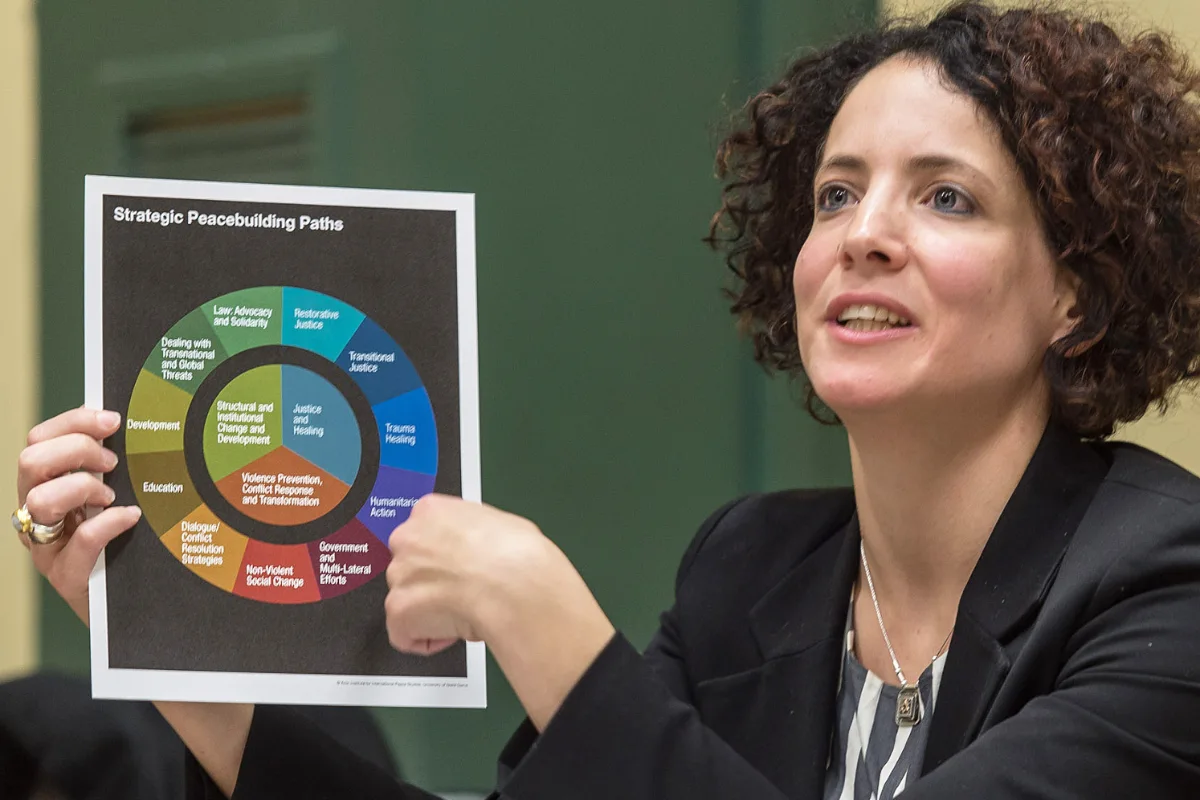
For over two decades, the supplementary major and minor in peace studies have provided students with the means to explore questions of peace, violence and justice.
Peace studies is an interdisciplinary field of study that seeks to understand the causes of violent conflict, to develop nonviolent ways to prevent and resolve all forms of violence, and to create more peaceful and just societies. It links scholarship to practice and educates students to be agents for change at the global, national and local levels.
This minor is proudly administered by the Keough School’s Kroc Institute for International Peace Studies.
Curriculum
Required Courses
9 Credit Hours
Both the supplementary major and interdisciplinary minor share a strong foundation in key peacebuilding concepts and methods. All peace studies undergraduate students take the following courses:
- Introduction to Peace Studies (3 credits)
- Perspectives on Peacebuilding (3 credits)
- Peace Studies Senior Seminar (3 credits, see below)
Note: Required courses must be taken in order and not in the same semester.
Senior Seminar
In your final year, you’ll complete your Peace Studies Senior Seminar, a writing-intensive course that brings together everything you’ve learned in the program. You’ll explore a central peace studies theme in depth and complete an independent research paper that reflects your academic interests and primary major. This seminar satisfies the University’s Writing 2 requirement.
Electives
Supplementary Major in Peace Studies
15 Credit Hours
- 2 core electives (6 credits)
- 3 core or support electives (9 credits)
Minor in Peace Studies
6 Credit Hours
- 2 core or support electives (6 credits)
Elective courses draw from a broad range of disciplines and topics. Electives are categorized as either:
-
Core electives: Grounded in peace studies research, core electives build specific skills or deepen knowledge in foundational thematic areas such as conflict transformation, justice, human rights, and peacebuilding theory. Examples include:
- Genocide in the Modern World
- Structural and Cultural Violence
- Engaging in Mediation Policy and Practice
- Social Movements, Conflict, and Peacebuilding
-
Support electives: Support electives provide complementary theoretical or practical knowledge from fields that intersect with peace studies—such as development, environmental justice, law, religion, or media studies—to strengthen interdisciplinary understanding. Examples include:
- Human Rights Reparations
- Visualizing Global Change
- Human Centered Design for Social Innovation
- Social Entrepreneurship

“Every approach to peace is intertwined with critical studies of religion, history, gender, and more. Peace studies isn’t just about ideals; it’s a comprehensive philosophy that informs how I engage with the world.”
Ready to take the next step?
For more information about the supplementary major or minor in peace studies, contact Anna K. Van Overberghe at avanove1@nd.edu.